The Sand Crab On The Rocks

It was too windy to play golf so I was taking the back way to town, looking to see if the recent rains had raised the river level. I looked down the riverbed as I crossed the bridge, and was surprised to see the Sand Crab sitting on a boulder near the shore. I’d never seen him away from the course, so my curiosity got the better of me and I pulled over. He apparently heard me crunching through the pebbles as I approached, because he flicked his cigarette into the water and looked over his shoulder in my direction. When he saw it was me he shrugged, waved, and lit another cigarette.

“Too windy for you, too?” he asked without turning around.

“The first big front of October always does it, Crabman. No cold, but a lot of wind. I’ve never seen you off the reservation before. The TV in the grill go on the fritz or something?”

He snorted. “I got a life, you know. It’s peaceful out here. Or at least it was.”

I let that remark slide and waited for the follow-up, but he just kept staring at the river. I gave up after a while. “I can leave if you want. I just wanted to say hello.”

“Nah. I’ve had my fill of peace and quiet. Do you cross the river here on your way to the course, or were you going somewhere else?”

“I’ve got a life too, Crabpot. I needed a few things for dinner and decided to take the long way into town, see how the river was doing. It’s up a little, don’t you think?”

“Maybe a bit. It still isn’t more than a foot deep, at the most. So you live near here?”

“A few miles from here. If I take the back way to the course or town, I come through here. It puts me in a good mood for a round if I can take the time to come this way.”

“You need to do it more. You’ve been cranked up a lot lately.”

“Meaning what, Crabs?”

“Your swing’s too fast about half the time, you jump at the ball like it might get away, I’ve even seen you lose your temper. That’s not you.”

“I’ve been pretty busy. It gets light later in the morning so I have to hurry more to make my tee time with all the stuff I have to do before I leave the house, and ….” I stopped talking when I saw he’d lost interest.

He pointed downstream. “You ever been around that bend in the river?” I shook my head. “I don’t have eyes in the back of my head. Either say something or come around where I can see you.”

“No, Crabs. I’ve never been around that bend.”

“That’s better. I haven’t either, and I’ve lived here all my life. I just drive through here, glance at the water, sit awhile like this about once every five years. Never looked around that corner. Never seem to have the time.”

I caught myself starting to nod. “I’m always on my way somewhere when I come here, too.”

He acted like he didn’t hear me. “It’s kinda like that tree on the eighth hole.”

“Which tree, Crabs. That hole’s full of trees.”

“The last big one, about 125 out. The ball magnet for second shots.”

“I’m getting lost here, Crabman. Explain.”

“I’ve played that hole the same way for more years than I can count. I keep telling myself I should try a different approach, stop trying to hit over that tree. But I keep doing the same thing, keep hitting the tree. I never take the time to try something new.”

“I saw you hit over it once.”

He laughed and flipped his cigarette butt into the water. “Once out of how many times? I’ve bounced it off the trunk into some OK spots more than I’ve cleared it, but I don’t try to hit the thing. I just look like I’m trying to.”

“So how’s that like that bend in the river? I’m still lost.”

“You got grits for brains, boy? Look, you and I drive by here over and over, think it’s a nice place. Right?” He waited a beat, and then continued. “I take it you nodded. We do the same thing, we don’t stop and take the time to check out something we think might be pretty good.” He stopped for another beat. “Say something, don’t just nod.”

“Go on, Crabpot.”

“We don’t even know what it’s like a few feet away from here. Never take the time. And I suppose you keep hitting at that tree, too. Just like me.”

“I’ve thought about other ways to play it. But I’m not sure I could hit that spot to the right of the tree where I’d have a good approach to the green. And if I did I’d probably roll downhill and into the rough.”

“I think the same thing. So you and I both keep doing something that we know doesn’t work because we aren’t sure something else will work. We never take the time to try. After all, it might be a waste of time, right?”

“Maybe. You know, I’m not even sure how far it is to that tree from where I’ve usually hit my drive. I just know I can sometimes clear it with a great shot.”

“Sounds like me. Pretty stupid, huh?” He jumped off the boulder and started untying his shoes. “I’m gonna wade around that bend. You want to come, or are you gonna keep hitting that tree?”

“How long do you think it’ll take to get around that bend, Crabman?”

“I have no idea. But I’m going to find out.”

I watched as he waded into the river. When he stopped and looked back I was taking off my shoes.

(Photo by Charles Prokop)

Posted in The Sand Crab | Tagged | 2 Comments

What’s Your Wampeter?

My regular golf buddies used to be guys I knew from work or school. I always had friends in high school and college that played golf, and it was easy to head out to the course after class, or cut class entirely when that first breath of spring took the chill off the course. (Yes, that happens even in Houston.)

When I was doing my psychology internship another intern and I scheduled our Thursday afternoons so we could get to the course by around 2:30 and get in 18 holes before dark. We always came back and took care of business after the round. We didn’t know it was a big deal, but we were shooting the breeze with a faculty member at a dinner after we had finished the program and we mentioned our afternoon escapes. Suffice it to say that it was a good thing we’d kept our creative scheduling quiet.

There was only one hospital I worked in where I didn’t have coworkers that I played with. Those three years were the longest I ever went without playing a single round. I found golfers at all the other places I worked, and we played together at least a little, and sometimes pretty regularly. My best coworker/golf buddy was an economics prof in North Carolina who had been on his college golf team. I learned a lot about golf and economics while he was beating me senseless.

My golf buddies these days are different. I really liked my friends from work and school, and I enjoyed playing with them. But golf with my current group is somehow different, somehow better. I think it’s because golf is what brought us together and it’s what we do together. We met at the course and playing golf together is what we do, it’s not something on the side.

Cat’s Cradle, by Kurt Vonnegut, Jr., deals with the fictional religion of Bokonon. Bokonon teaches that people are organized into teams doing God’s will, but the people don’t really know what they are doing. A team is called a karass, and it’s organizing principle is called it’s wampeter. I have no idea what the cosmic purpose of our little karass on the golf course is, other than having fun, but I’m glad God gave us golf as its wampeter.
I have a feeling that I have so much fun playing with these guys now because we are together because of something we love and do entirely by free choice, not because of something we do to make a living. We weren’t thrown together and then discovered we played golf. We formed our little karass of our own free will. We weren’t hired into it.

Bokonon would say that my previous golf groups might have been granfalloons, or false karasses. Granfalloons seem to be teams, but they are organized around ultimately arbitrary principles, things that are meaningless to God’s way of doing things. Back when I was working I would have thought students, psychologists, and university professors were important karasses. It all seemed to be pretty meaningful at the time.  But the longer I’m away from it, the more I wonder if they weren’t really granfalloons.

I know that after I walked away from work I never longed to go back. But whenever I’ve walked away from golf, I’ve always returned.

It’s really too bad that granfalloons pay so much better than karasses.

Posted in reflections on golf | Tagged , , , , | Leave a comment

Hit It Charlie Short

The November issue of Golf Digest features Bubba Watson’s instructions for “hitting it two clubs longer.” I was particularly intrigued by his comment that his lips were permanently chapped from rubbing them against his shoulder at the top of his backswing. Get up from your chair right now and try to make that turn. No cheating by sticking your neck out to kiss your shoulder. How’d you do?

Two flavors of Chapstick

Essential golf accessory for those who hit it like Bubba. Image via Wikipedia. In the Public Domain.

I’m a reasonably flexible guy. Admittedly, I turned 61 this summer, but I still get around fine, have no trouble touching my toes as I limber up, can get several knuckles on the ground with a little stretching, etc. I’m sure I could get more flexible, but my backswing goes back as far as many of the guys on the Champions Tour, and farther than some of them. But getting my shoulder under my lips? Ain’t gonna happen, even if I am willing to increase my Chapstick budget to the amount Bubba must spend on it.

I took some lessons about 10 years ago from a pro that wanted me to make a more complete turn. He was about 30, I was about 50 at the time. When I took it back as far as he wanted me to I exploded from the top, kind of like a rubber band snapping and flopping around uncontrollably. Contact in the general vicinity of the ball was by no means certain. My position at the top looked great on video, though. (To the guy’s credit, other parts of what he taught me were helpful.)

I think I’ll take a pass on Bubba’s suggestion. Hank Haney’s suggestion in the same issue to take enough club to get to the back of the green makes more sense for me. That way, if I hit it two clubs shorter I still might hit the front fringe. That’s a lot more likely than me hitting it two clubs longer.

Posted in daily golf issues | Tagged , , , , | Leave a comment

Tight Lies And Thin Shots

I was playing golf the week after the British Open several years ago and one of the players in my group said that the Open course looked like a cow pasture. We were playing that day on a well groomed, very green course, and it was a real contrast to the natural links of the Open. I think this was the year it was played at Hoylake, but whichever year it was, there had been very little rain and little or no irrigation of most of the course, so the Open course was browned out in many areas.

I defended the conditions at the Open, noting that it was a very different type of course than those we typically played, and that it was closer to how golf was originally played. My friend wasn’t impressed, and I have to admit I liked the lush course we were playing.

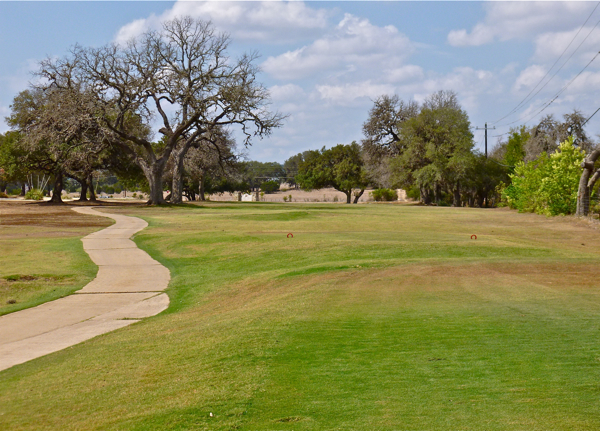
Our ongoing drought has made me think a lot more about how course conditions affect my enjoyment of the game. My home course is doing a good job of balancing fighting the effects of the drought with reasonable water conservation, but the extremely dry conditions are taking their toll. The fairways, greens, and tee boxes are in good shape, but the rough has become dry grass and bare dirt in many areas. The picture below shows a view down a fairway from the tee box, and you can see that the tee and fairway is green, but off to the other side of the cart path is bare dirt. That used to be bermuda grass. The fairway is also typically much greener than it is now, but it is healthy when in the light green color in the photo.

Our course is in better shape than some others around here, and it is in much better shape than my own yard. Some of the courses have very restricted water access, and I’ve played a few where the fairways have lost a lot of their grass. My yard is primarily mulch, bare dirt, and dried, fallen leaves.

It’s easy to get frustrated with the conditions and let them reduce your enjoyment of the game. Thin, bad lies are nearly unavoidable in the rough and it’s hard to remember that you shouldn’t have hit it there in the first place when you are staring down at a ball resting on hardpan. On the other hand, you get a lot of practice at nipping balls off of tight lies.

I’ve been working on remembering why I’m really playing and not getting too caught up in my score. My scores aren’t as good, partly because of a continuing slump and partly because bad shots are easy to hit and severely punished right now. But if I remember that I’m out doing what I love, playing golf with friends I enjoy, I do OK. The weather has been pretty good in its own way. After all, we don’t get rained out.

We have an ambivalent relationship with the courses we play. We play against the course and it’s our job to beat it, to dodge all the traps it throws our way. But at the same time we want it to be welcoming and to lie softly under our feet. The drought has just emphasized the adversarial side of the relationship.

Posted in reflections on golf | Tagged , , , , | 3 Comments

Concerto For Pitching Wedge And Bassoon

My major extracurricular activities in high school and college were band and orchestra. I was a fast, but gangly, receiver and would have been seriously broken when hit by the football players at my large Texas high school. (Think Friday Night Lights.) I had good friends on the golf team at that same school, but regular drubbings from them made it clear the golf team was not in the cards.

My family had a strong musical heritage. That’s my grandfather in the picture, decked out for his violin performances in the early 1900’s. My father had played oboe, my mother had played alto clarinet, and it was assumed that I would play something too. I was up for it, and ended up playing bassoon.
I never got as good as I should have (golf, sandlot football, and daydreaming about girls demanded a lot of time that might have otherwise gone to practice) but I got to where I didn’t have to think much about what my body was doing as I played. I read the music or imagined the melody and translated it into sounds without thinking.

It became automatic, like any well learned physical skill should. In fact, too much thinking would ruin the music, as it got too mechanical and lost the flow. It would sound and feel clunky, even if the notes were right.

When it all felt right the sounds came out of the bassoon without any sense of the instrument being in between me and the music. It was like I thought the sounds, they somehow appeared, and I got lost in them.

It’s occurred to me that my golf swing is a lot like my bassoon playing used to be. With a lot of play and practice my swing becomes an overlearned physical skill. Too much thinking about my swing can wreck it. Too many swing thoughts, too much monitoring of muscle movements, and my swing becomes stiff and clunky. I may hit the right positions, but there’s no flow. The club feels unwieldy, and when I hit the ball I feel a noticeable bump.

But when I’m playing well I don’t think about how to execute, I just execute. I’ll plan the shot, just like I’d plan how to play, but when I swing it’s thoughtless. I don’t feel the club between my intentions and the ball. I just move my body and the ball goes. There’s no bump as I contact the ball. I’m immersed in the round, the feel of the course, the music of the game.

Jack Nicklaus said that he’s played a lot of good rounds to Jamaica Farewell, and that it’s hard to play poorly to Raindrops Keep Falling On my Head.  I generally play well when the right song is stuck in my mind, but I’ve never been very good at sticking the right song in there.

Maybe I’ve been approaching it from the wrong direction. Maybe it’s not just hearing the music. Making the music may be more important.

Posted in reflections on golf | Tagged , , , , | 1 Comment

Tee It Waaayyy Forward

I was making my semi-regular tour of the golf sections of my local book stores and found two interesting books. The first was a copy of Jimmy Roberts’ Breaking the Slump. It should make for interesting reading and might even be useful, given the recent status of my game.
But the real find was a book on clearance for the princely sum of $3.00. It jumped out at me because the cover is surfaced with artificial turf. It’s titled Miniature Golf (photos by John Margolies and text by Nina Garfinkel and Maria Reidelbach) and is a history of that glorious and oddball game. The book is full of (often hilarious) photos of miniature golf course holes and courses, obscure historical facts, and early newspaper and magazine stories about the game.

Eternite Miniature Golf Course in Germany

I had no idea that miniature golf was a craze in the 1920’s, and became big enough in the 1930’s that the USGA issued a statement that “Tom Thumb golf” came within its rules and governance, so accepting cash prizes for miniature golf was a violation of USGA amateur status.  Tommy Armour and Gene Sarazen even showed up to play in the First National Tom Thumb Open.

Hollywood stars such as Mary Pickford , Fay Wray, and Jackie Coogan were big fans, even though major studios discouraged star involvement in the game because the public was staying away from theaters to play mini golf at night. A L.A. Times reporter suggested that women were naturals at the game because of their “hereditary gift of wielding a  broom.” (If you are particularly suicidal, try injecting that into the current debate about long putters.)

The game declined and nearly disappeared in 1931 as zoning laws cracked down on course locations, lights, and noise at night. Prominent figures came out against it. Will Rogers said people should have shovels in their hands rather than putters, and at least one columnist went after Herbert Hoover for not condemning the game as contributing to unemployment. You can almost hear Trouble in River City from The Music Man playing in the background.

The book also covers the games reemergence in the 1950’s and courses of today. I remember Saturday afternoon televised professionalPutt-Putt tournaments in the early to mid 1960’s, although the book doesn’t cover that weird little episode in the game’s history. The tournaments struck me as ridiculous, but I watched when I couldn’t get a sandlot football game up.

This book has earned a place of honor on my shelves. My only problem is figuring out how to display it – it would be a real shame to hide that artificial turf.

(Miniature Golf Image by Sven Teschke, Creative Commons Share Alike 2.0 License. Image via Wikipedia.)

Posted in book thoughts, humor | Tagged , , , , , , , , , , , , , | Leave a comment

Pull That Cart With Pride!

I was eating breakfast and idly watching Morning Drive on the Golf Channel this morning when the subject of pull carts came up. It was the friendly banter before the break, but the theme of the comments was that they’d run if they were paired with someone who came up to the first tee with a pull cart, no one under 50 should use one, it’s OK if you’re an old fart that needs the exercise, etc.

Joking or not, this punched one of my buttons. People sometimes wonder why golf gets a bad name, and this was a nice illustration of one reason. It’s somehow considered cool to stereotype players on the basis of superficial characteristics.

Golf is a sport touted for it’s accessibility to all ages, both genders, the whole family, etc. All social and economic distinctions presumably disappear on the course, as the pipe fitter is paired up with the neurosurgeon and they spend a pleasant day strolling the fairways discovering how much they have in common through the love of this great game. (Obviously an exaggeration for effect, but not too far off of what you’ll hear in the ads pushing golf as a game for everyone.)

I don’t expect everyone to be delighted to play with everyone else. I’ve got folks I like to play with and folks I’d just as soon avoid, too. But it’s not because of whether they carry, pull a cart, or ride. It’s not because of their clothes, their clubs, their age or gender, or even their handicap.

It’s because of whether or not they are interesting and pleasant to be around, whether they play the game honestly or are always looking for that little cheat, and how they accept the inevitable bad breaks and bounces of the game. I’ve met some really interesting people in random pairings, and I wouldn’t have got to know them if I ran. I’ve become friends with some of them and I’ve never seen some of them again as we both moved on.

And some of them pulled a cart. (And no, I don’t.)

Pardon the rant, but I feel better now.

Posted in reflections on golf | Tagged , , | Leave a comment

What A Stupid I Am

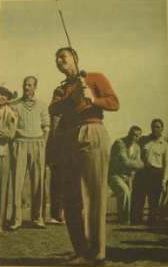
You golf historians out there will recognize the title of this post as the famous words of Roberto DeVicenzo. To refresh everyone’s memory, DeVicenzo said this after signing an incorrect scorecard that cost him a spot in a playoff with Bob Goalby for the 1968 Masters championship. Tommy Armour had recorded a 4 for DeVicenzo on number 17 when he’d really made a 3, and DeVicenzo didn’t catch the error.
Lately I’ve been feeling a bit like Roberto, although my stupidity doesn’t have nearly the same consequences as did his.

After a stretch of the best golf of my life, I decided to make some changes to get even better. (Laughing, catcalls, and jeering are quite appropriate here.) I particularly thought I needed to be sure I minimized my chances of coming over the top. That’s been a recurring problem for me, although there was no good reason to think it was causing me a problem at the time. It was just to be sure, you know. That extra dose of medicine.

So I broke my own rules and made the mistake of listening to what commentators and golf tips people said. I settled on two things, both of which seemed plausible based on my swing history. I tried to flatten my swing out a little, a la Matt Kuchar, and I tried to slow down my transition. I’ve always been at risk for a quick transition, although I actually play best when I find a quick, but not too fast, tempo. A pro once tried to slow me down and then decided quicker was normal and better for me.

The end result was I lost my tempo and my ball position. My ball striking went down the tubes. I’m hitting everything on the heel, and shanks are a real risk for the first time in my life. I’ve never been a natural draw player, but now I can’t get any draw at all. I’m coming over the top more than I have in a long time. I have no balance.

I’ve been slowly recovering, and feel like I may be getting close again, although my scores haven’t yet caught up. My tempo isn’t natural yet, but I’m getting glimpses. My swing did flatten a bit and my arms are better extended. That’s probably what is making me hit it in the heel, and I need to get comfortable standing a little farther away from the ball at address. I used to stand too far away, so that’s a challenge.

Anyway, I may have learned my lesson (again). I like the Golf Channel and Golf Digest, but listening to the tips they give has always screwed me up. I guess I was looking for that one little extra thing to get me over the top. That pun was accidental, but is an entirely appropriate ending.

(Image from Revista El Grafico, July 18, 1950. Author not stated. Image via Wikipedia.)

Posted in daily golf issues | Tagged , , , , , , , , | Leave a comment

How To Make Golf More Popular

There’s been a lot of concern expressed recently about a drop in golf’s popularity. Apparently golf is too difficult and takes too long to play, so 12 hole rounds on courses with larger cups and shorter holes will bring ’em back in droves. On the other hand, we can’t let them putt at those bigger holes with a putter that makes putting easier, and we don’t want the ball to go too far on those holes that we’ve shortened because they were too long. (A prize package awaits anyone who can figure out how these ideas are consistent. It’s above my pay grade.)

In the spirit of increasing the popularity of golf, I have a few additional suggestions. I offer some of these from my perspective as a psychologist and some from my perspective as a misguided soul who has been willing to play this poorly designed game for years. I present these suggestions with the sincere hope and expectation that the number of golfers will increase exponentially. The good Lord knows how much I love crowded courses and making tee times weeks in advance.

First, the concept of handicap needs to be entirely rethought. The word itself conjures up a negative image by suggesting a deficit in ability. Instead, it should be called a “potential excellence indicator.” Imagine how much better you’ll feel to say “my excellence indicator is 20” instead of “I carry a 20 handicap.” One lifts you up, the other drags you down. The time honored practice of sandbagging will be known as “strategic excellence enhancement.”

Second, rough and hazards should be eliminated from all courses. Not only will everyone feel better when every drive is in the fairway, but rounds will naturally speed up when hunting for balls becomes a thing of the past. No more wading into the weeds or fishing in the pond. Your ball will just be sitting there in plain view on the closely mown grass, no matter what direction you hit it. And golf will immediately be cheaper when it’s next to impossible to lose a ball.

Third, a player may play any number of holes he or she chooses and it will be deemed a full round. Scores will be adjusted to a standard of 18 holes for the calculation of the player’s excellence indicator, but this in no way suggests that the 18 hole round is an expectation or a goal. After all, the 18 hole round is an arbitrary conception, just like the number of clubs in the bag or the characteristics of the legal club and ball.

Fourth, since 12 hole rounds seem to be the emerging popular choice, it wouldn’t be fair to penalize those old fogies traditionalists who insist on playing the antiquated standard 18 hole round. If more than 12 holes are played, the player may eliminate scores on any holes of that player’s choosing to provide the score to be recorded. The excellence indicator will be calculated from this adjusted score. Players may do this in advance by skipping the hard holes.

Fifth, the “gimmee” will finally be made an official part of golf. All putts shorter than the length of the longest putter carried by any competitor in a players group will be called good. It’s harder to miss putts with large holes, anyway, so this will not distort scores. It will only speed up play. It will also lead to interesting strategy decisions as players choose putters.

I trust these suggestions will find favor with golfers everywhere. I know my love for the game would have been immeasurably increased if it would have been much easier to play from the start of my golfing career. I could have mastered it early and gone on to more rewarding pursuits, like …….. uh …… I’ll think of something ……….. uh ………. How ’bout them Cowboys?

Oh, wait. The idea was to increase the number of players, not encourage them to play for a while and then quit. I guess the problem is above my pay grade. My bad.

Posted in humor | Tagged , , , , | Leave a comment

Channel Your Inner Fozzie Bear

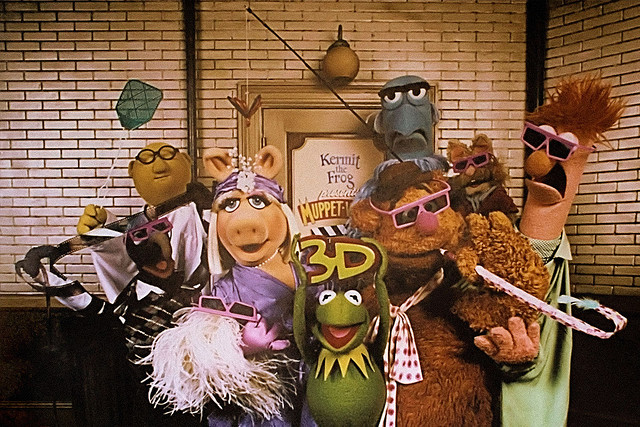
Sam the Eagle acted as the moral guardian of The Muppet Show. He routinely expressed outrage and offense at bad jokes and behavior he thought beneath the dignity of the show’s high (at least to him) standards. The other characters on the show seemed to have a lot more fun than Sam. That’s him in the back, glaring at the camera.

Image by Express Monorail, Flickr.com

I often find myself fighting against turning into Sam on the golf course. It’s easy for me to get disgusted with my game, despite the evidence that my standards aren’t, or at least shouldn’t be, that high. I hit a few crappy (OK, not too far below average) shots, and Sam starts to mutter in my ear and crawl inside my head. After a while I’m fuming and harrumphing down the fairway.

Unfortunately, eagle flu is contagious. Let a few other members of my group have a bad day at the same time as me and we’re all soaring with Sam. The Chipping Lizard starts to chunk it around the green, Gallon loses his putting touch, and the Cowboys start to hack and bang. By the time we’re through we’ve all had rounds to forget.

But how much difference is there really between those good and bad rounds? If I crank out a mid 70’s round, I feel pretty good. Very good, in fact. If I shoot low 80’s I start to feel like it was pretty bad. Mid 80’s stinks.

Compare that to the pros.  Look at the scores in a regular weekly tour event. Look at the whole field, not just the guys at the top that week. You see a lot of mid 70’s, some upper 70’s, a few 80’s. This from guys that can crank rounds in the 60’s with no problem. I know the guys that shot those scores probably feel crappy and have eagle flu, but they’re the best in the world. They play all the time, it’s their life. I have no business feeling bad about my scores if that happens to them.

I’m going to play this game, for better or worse, as long as I can drag my feet down the fairway and make contact with the ball. I’d have a lot more fun if I listened to a new Muppet. I’m going with Fozzie Bear from now on. That noisemaker looks like it could be real handy on the green.

Posted in reflections on golf | Tagged , , , , | Leave a comment