Anchors Away?

I think I’ve noticed a subtle shift in the way the long putter debate is being framed. When the recent run of long putter wins began, including Adam Scott winning with the sweeper and Keegan Bradley winning with the belly putter, the commentators were talking about the use of the “long putter.”

Then Bones Mackay was on Feherty’s show, and said that he thought putters that are in contact with the body, or anchored putters, should be outlawed. (I thought that would lead to an interesting debate with Fluff Cowan, given that Jim Furyk uses a belly putter these days. But I bet Phil Mickelson’s foray into belly putting led to much more entertaining conversations.)

Phil using the belly putter elevated the debate, and I noticed commentators beginning to talk about the “anchored putter” rather than the “long putter.” I suppose if an argument for outlawing either the sweeper or the belly putter could be made, it would be much easier to do it based on contact with the body rather than putter length.

Belly putters obviously need contact with the body if they are to be belly putters. You could use a sweeper without making contact anywhere but in the hands and get a good pendulum motion. Whether or not that would be more effective than a traditional putting style would probably vary with each individual golfer. Face-on putting with a long putter is unlikely to rely on anchoring the club to chest or chin. You can get stability by resting your forearm on your torso, and many putting other styles rely on holding body parts together (elbows to sides, Arnold Palmer knees, whatever).

Whether or not it should be illegal to anchor a club to the body will be up to the USGA and R&A, not me. I suppose you can argue that it isn’t a golf swing as originally intended if a club is anchored, but the modern ball isn’t a golf ball as originally intended. I don’t think it’s true that “it’s gone too far to be made illegal.” It’d be easier to outlaw an anchored putter than it was to outlaw square grooves.

The argument that makes the least sense to me is that the long or anchored putter is an unfair advantage. Anyone can use any putter or putting technique if it works better for them. It’d be more logical to say that top of the line clubs and balls are an unfair advantage – we all can’t afford them. And I don’t think they’re going to make Wal-Mart specials the only legal equipment on tour.
 

Posted in PGA Tour | Tagged , , , , , , , , , , | 2 Comments

The Sisyphus Blues

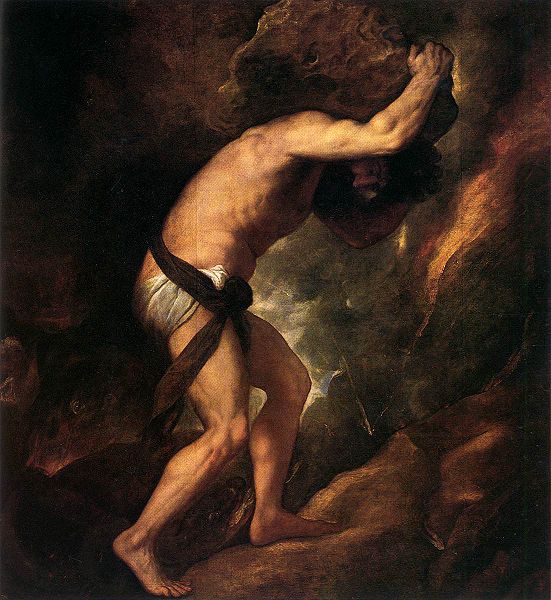
Like most players, my game goes through cycles. I find some things that work and I use them until they quit working. I keep tinkering even when I’m playing well, and eventually the house of cards comes tumbling down and I have to start over. It’s like I’m Sisyphus hauling the rock up the hill, watching it roll back down, and then starting the long, hard trudge back up the hill. I don’t know what I did to offend Zeus, but it must have been bad.

Sisyphus, painting by Titian, Prado Museum.

My normal shot shape is a fade, but the tougher holes on my home course favor a draw. I learned to hit a baby draw with the help of a golf training aid, The Inside Approach. The idea is you learn to swing under the overhanging styrofoam baton, and you have to come from the inside to make the swing without hitting the thing. It worked pretty well for me.

Unfortunately, after a while the draw swing starts to feel like my old swing, so I exaggerate the moves. My draw turns into a hook and I get in more trouble than I did with my fade. I hear Lee Trevino in the back of my mind, telling me you can talk to a fade, but a draw won’t listen. So I square my stance back up and try to feel my old swing. I start to hit the fade I know so well, it starts to feel natural, I exaggerate it, I start to hit weak slices, and around I go again. Up and down the hill, over and over.

I hit the bottom of the hill again this last Friday’s skins game. I’d been losing power and hitting it farther right, and my scores were showing it. After three doubles on the first half of the back nine I was planning on skipping my regular Monday game, taking the week of Labor Day off from golf, doing other things, and trying anew later in September. They are punching the greens anyway after Labor Day, so it’s a good time to take a break.

So I started to fool around, tried to feel like I was swinging like Tom Lehman or Kenny Perry, tried to feel that in to out move they have at the bottom. As you’d guess, I started to hit solid draws, went two under over the last four holes, and won two skins.

I’m playing tomorrow.

(Sisyphus image from Wikimedia Commons. Art in public domain.)

Posted in daily golf issues | Tagged , , , , | 1 Comment

Can You Explain This?

What you see above is the last 125 or so yards of the 13th hole at my home course. It’s a well-designed risk-reward par 5. It’s reachable in two but wayward second shots often find the bunker at right, the woods on the left, or hit the rock wall. The most common lay-up is just short of the (usually) dry creek bed just in front of the rock wall.  Scores from eagle to the dreaded “other” are possible.

It is also the site of the strangest shot I have ever seen. It happened a few years ago, before my regular group had formed. I was playing with a group of guys of varying ages and abilities, and all but one of us were on the green. One player was playing his fourth shot from 40-50 yards short of the green, in between the rock wall and the green. (It’s about 80 yards from the rock wall to the center of the green.)

This player is a real character, a former rodeo cowboy and oil well wildcatter who is now in his eighties. I think he was in his late seventies at the time of the shot I’m describing.

As all of us on the green watched as he addressed the ball, looked up at the green, and then stepped away. “Pull the pin,” he shouted. We all looked at each other in confusion, then looked back at him. “Pull the pin,” he shouted again.

I shrugged, walked over to the hole, pulled the pin, and stepped away. He addressed the ball again and proceeded to hit the ball a few feet short of the hole, where it rolled like a putt and dropped. He then nonchalantly walked toward the green, as if he had just made a three footer rather than a 50 yard wedge shot.

I’d never seen him ask to have the pin pulled before, and haven’t seen him do it since. I have no idea what possessed him to do it then. I’ve seen people make shots from about anywhere, but I’ve never seen them call it like that.

Go figure.


Posted in golfing memoir | Tagged | Leave a comment

Process, Outcome, and Tiger Woods

It’s a truism that we play our best golf when we stay in the moment, don’t get ahead of ourselves, and focus on the process of play rather than the outcome. If we stay focused on the shot at hand rather than our score we give ourselves the best chance for a good round.

When I think back over my golf career and the rounds I remember and enjoyed the most, I don’t recall “that round when I shot even par.” I recall “that round when my swing felt so good” or “that round when the 18th fairway was so beautiful in the twilight.” I remember the process of the rounds, not the outcome.

There’s no surer way to destroy a good round than to start thinking about the score. If anyone out there hasn’t blown a great score by realizing you could shoot your personal best by just playing halfway decent over the last three holes, there’s a spot waiting for you in the hall of fame.

It’s my guess that focusing on process over outcome wasn’t a big problem for most of Tiger Woods’ career. When the outcome is so consistently good there’s little temptation to be drawn away from process into distracting thoughts about the results. We all came to expect that Tiger would do what Tiger did, that he’d hit those shots only he could hit, and he’d make those clutch putts to win. I’m not privy to his private thoughts, but I imagine he expected it too. Why wouldn’t he? His history said that’s what would happen, and it happened to him with incredible consistency. Just be Tiger Woods and the outcome takes care of itself.

But things are different now. That great outcome isn’t so certain for Tiger, and everyone is asking when he’ll be back to his winning ways. When he’s asked how his game is coming along, that’s an outcome question in disguise. People are really asking when he’s going to win again. But Tiger’s answer shows he knows that outcome isn’t where he needs to be focused. He says it’s a process, that his game is coming together, that he just needs time to heal and get back into competitive golf. But then the outcome disappoints, attention is drawn away from the process of recovery and toward missing the cut, and we’re all back to asking the outcome questions. Will he win or place high at the Fry’s.com? Did he pick that venue because he thought he could win there? Will he win matches at the President’s Cup? Is he playing well enough to justify the pick?

I like to play well, but I can enjoy a round while I play less than my best. After all, that’s what I do most of the time. Playing golf does not equal playing great golf for me. It doesn’t equal great golf for most of us. I remember an interview with Jack Nicklaus several years ago when he was asked if he was sure he should stop playing in competition. After all, his performance showed he could still make the cut. His answer was something like “Well, that’s the point, isn’t it? I don’t play just to make the cut.” Playing golf for Jack isn’t what it is for most of the human race, and it isn’t for Tiger either. A big part of the process of playing golf has been an unheard of level of success, and now that outcome has been separated from the process.

I have no idea if and when Tiger will return to his winning ways. I don’t think anyone does. But he hasn’t looked like he was enjoying himself very much the few times he has played during the past months. Playing and winning with ridiculous frequency were synonymous for him in the past, and much of the enjoyment of and commitment to golf must have been derived from winning so often. Getting back to winning may require more enjoyment of the game itself, with less attention to the outcome.


Posted in PGA Tour | Tagged , , , | Leave a comment

You’re How Old? And Your Handicap Is What?

When I was younger I usually played golf with guys very close to my own age. I played with coworkers or people I went to school with 99% of the time, and they were seldom more than 10 years older or younger than me. Differences in physical abilities weren’t all that large.

Now that I’m 61 I’m playing with groups that vary a lot more in age, strength, and health. The groups I play with these days range in age from around 50 to over 90, although there aren’t many past their late 80’s. In my youth I would have considered my 61 years to be approaching old fartdom, but now I’m one of the young bucks. It’s funny how things change.

Old Tom is our newest regular player.

Handicaps in my current crowd vary as much as age, and there is by no means a perfect correlation between the two. The challenge for us is arranging matches that give everyone a decent chance without making the low handicappers feel taken advantage of and the high handicappers feel like either freeloaders or losers, depending on their worldview.

We’ve come up with a few systems that seem to work pretty well. One large group I play with uses a modified stableford format. A player’s performance over their first three rounds with the group establishes the number of points they need to earn to be in the money on their next round. A double bogey on a hole earns 0 points, a bogey one, a par two, etc. There are no negative point values, so you can pick up at double. If your play improves you’ll earn more points than your target score, and your target score will also increase for your next round. Play worse than your target score and you’ll need fewer points next time.

Sandbagging is impossible in this system, or at least it’s stupid because you pay your entry fee each time and intentional poor play to lower your target will likely cost more than you’ll win when you play better. Players of a wide range of abilities can compete equally because you’re competing against yourself. It doesn’t matter how much better or worse you are than anyone else. All that counts is how you do relative to your own prior performance. The play of other players only affect point value. If a lot of people make points, points are worth less as the pot gets divided more and more finely.

Another group of us plays a regular skins game. There is a gross and a net competition in each game, and players can choose to enter either or both. The low handicappers sometimes enter only the gross and the high handicappers often enter only the net, but entering both is common and profitable if you play well. The net game is played off the low handicap entered that day, which usually ranges from 5 to 8. The only restriction is that no more than one handicap stroke is allowed on any one hole. There are no carry overs. We just get together and compare scorecards after the round and divide the pots by the number of skins made.

One good hole can make your day worthwhile, and a high handicapper has a good shot at a win in the net game. If a low handicapper doesn’t like giving strokes, they can stay out of the net game and only play in the gross. I typically get few or no strokes in the net from my handicap (currently a 7), but I’ve found that playing in both the net and the gross works well for me. The same hole will often pay off in both, especially if it’s a birdie on a tough hole.

In addition to the larger skins or stableford tournament, we often have a wolf game going in my foursome or fivesome. Handicaps in my group range from around 6 to the mid 20’s, with ages ranging from mid 50’s to late 70’s. We give a few strokes to the high handicappers in the wolf games, but not many because the best ball system washes a lot of the differences out. Some of us may also have a nassau going against players of roughly equal abilities in some other group.

It can get pretty complicated when someone is your opponent in the wolf game and your partner in a nassau, and you are trying to cover up their birdie to keep a skin alive. But it’s fun and the answer is always the same anyway – try to make the stupid birdie.

Just in case you’re adding up the money rolling around, don’t bother. At the stakes we play for a big day pays enough to buy the other guys a beer. The only advantage is you get to do it with their money.

Posted in daily golf issues | Tagged , , , | 1 Comment

Is It Easy Or Hard To Have Fun?

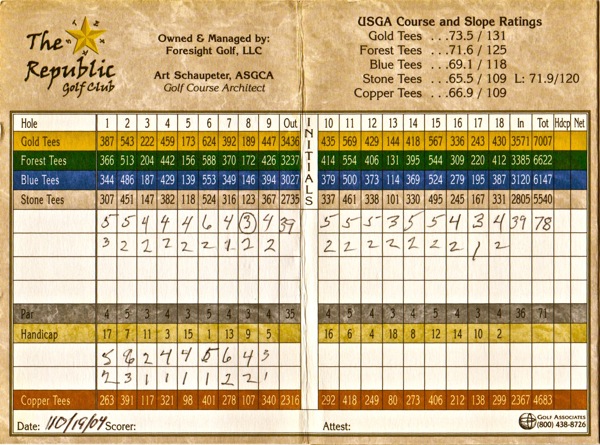
I didn’t break 80 until I was 54 years old. I know how old I was because I saved the card. I’d been playing golf on and off for around 40 years, so my first score in the 70’s was a really big deal.

The first time I broke 80. Woo-hoo!

Up to then my best round was a not entirely legal 82. When I was 16 years old I played with a good friend on a country club course that was closed on Mondays. He was a member and they’d let me play with him on Mondays for free as long as we were willing to dodge the maintenance projects. One day they had sanded the greens and they were nearly unputtable, so we gave ourselves two putts once we got within about 20 feet, leading to my 82. My lowest honest score before my first 70’s round was 83, and I had several of those.

For most of my golfing life, I was delighted to make the turn in under 45 strokes. That let me feel the 80’s were in reach. Now I’m disappointed if I make the turn in over 40 because it means I have to work hard for my 70’s round.

But am I having more fun playing golf? Maybe, but it’s not due to the scores. In fact, my expectations for good scores sometimes get in the way of having fun. I’m playing more regularly with a group of guys I really enjoy. I like shooting better scores and I feel really good after a near par round. But I can have a lot of fun while I’m shooting a bad score, if I’ll let myself.

I guess that’s part of what’s been bothering me about the recent focus on trying to make the game easier so more people would play. I wonder how many people quit playing because the game is hard. Maybe some do, but I kept banging away for 40 years, playing poorly and loving the game. Part of what kept me going was knowing this hard game could be played well, or at least a lot better.

I’m willing to bet that more people stop playing because of their social experiences on the course than because of their playing ability. Golf is advertised as a game for life, a game for the whole family. Images of kids, moms, and dads strolling the fairways together are an advertising staple.

But what happens when that family really hits the tee? What happens when an old guy and his wife come to the course for a day of fun? Half the time they get a gratuitous lecture from a starter about keeping up the pace of play. They hear grumbling from other groups waiting to tee off. They get a marshal on their tail out on the course, even when they are keeping up the pace nicely. They get singled out as the reason for slow play, even when they are stuck in the middle of a logjam caused by a group of delusional hotshots playing the tips and stalking the greens like they were on tour.

Just like I’m sure you have, I’ve been stuck behind the family while the kid whiffs ten times. I’ve watched and waited while the old and the young (and middle aged) top, foozle, and bunt the ball down the fairway. I’ve topped, foozled, and bunted myself. But most of the toppers, foozlers, and families have let me play through. Fewer delusional hotshots have let me play through.

Of course we should all use the tees appropriate to our game. After all, the PGA, LPGA, and Champions tours don’t use the same tees. We all need to have at least semi-realistic ideas about our game and abilities. Go ahead and use a big hole for a special event sometime, as long as your greenskeeper can put things back together without damage. And if you’re slowing the course down, let folks play through.

But to really have more people playing golf? Let them have fun doing it. Golf isn’t a forced march over 18 holes. It’s a game.

Posted in reflections on golf | Tagged | 2 Comments

Can I Fire Myself?

One of those McGladrey commercials has Davis Love III’s bad caddy telling him all the bad things that could happen on a putt, pointing out that his opponent just eagled, and then walking away wishing Davis luck. Davis just stares at him as he walks away and says “Thanks a lot.” Lately I’ve been playing the role of Davis and his caddy.

My home course has the threat of out of bounds on every hole. Until a few months ago I’d been O.B. on all but two of the holes. Now it’s down to all but one.

I was needing new grips a while ago, and my clubs (especially mid-irons) were at risk for slipping just before impact. I hit a few shankaroonies during this time, including one off the tee of the 17th, a par 3 I’d never been O.B. on. As you can guess, it went O.B.

"The Scream" by Edvard Munch. Image via Wikipedia.

I’ve now regripped my clubs, but every time I step onto the 17th tee my mind fills with the image of a weak shrimp toward the O.B. fence. I can hear my internal bad caddy saying “Don’t go right. See that fence over there? Don’t think about it. Forget about that shankaroonie you hit.” I’ve hit another one out, several shrimps half-way to the green, and some big pulls as I executed a don’t-go-right swing. This is all new to me – I never thought about a shank or shrimp before.

It’s beginning to infect other mid-iron shots. I hit two others today, in addition to one off the 17th tee. Needless to say, it’s wrecking my game, and it’s wrecking a part of my game that used to be one of my strengths.

So I’m on a search for replacement thoughts, or at least a lack of bad thoughts. Maybe a nice song drifting through my mind, something with a good swing tempo. Maybe a lobotomy.

There still is one hole left I haven’t gone O.B. on. It’s a par 3 too, with O.B. on the right. The hole slants away from the fence and the road, so it’d take a really bad shot to go out. I can imagine how bad that shot would have to be.

“Got my toes in the water, …, life is good today.”

“Blue eyes cryin’ in the rain…”

Anybody have a lobotomy kit? Maybe there’s one on e-bay?

Posted in daily golf issues | Tagged , , | 2 Comments

How The Lizard Got His Name

Once upon a time there was a group of five merry golfers. Games of skins and wolf under the bright Texas sun filled their hearts with joy, and cries that cannot be repeated in polite company echoed across the rough and from the deepest bunkers of the land.

On one very, very special day the Cowboys, Gallon, my humble self, and the Lizard-Who-Had-No-Name were on or near the green in earnest discussion of the affairs of the day. You must understand, oh my Best Beloved, that silence only made the merry golfers look up from their shot to see what had happened. Chatter was the reassuring sound of peace in this fine land.

Much to everyone’s surprise, the Lizard-Who-Had-No-Name chipped into the hole for a stunning birdie and a win. As is often the case, this delighted some of the merry golfers and disgusted the others. In wild celebration, the Lizard-Who-Had-No-Name called out “I’m a Chipping Wizard!” Indeed, I must in all fairness report that the Lizard-Who-Had-No-Name had been, and still is, widely recognized for his chipping skills. But this day was the first he had celebrated in such an unseemly fashion.

As the merry golfers trudged to the next tee, their chatter woke the squirrels in the trees and the ducks in the pond. So it was that all the wide, wide world witnessed the amazing transformation. The Chipping Wizard left the green as the Wizard but emerged at the next tee as the Chipping Lizard. None of the merry golfers accepted responsibility for this marvelous feat, but all were pleased.

And that has been his name from that day forward.

(All due apologies are extended to Rudyard Kipling and his marvelous Just So Stories.)

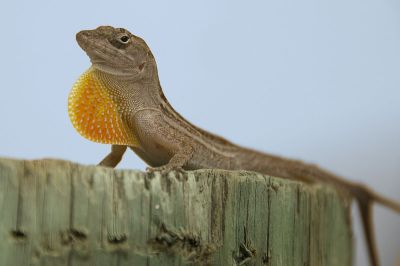
(Lizard image by Alberta p, Creative Commons License, via Wikimedia Commons)

Posted in humor | Tagged , , | 1 Comment

A Trip Back To 1976 Greensboro

One Sunday in the spring of 1976 my wife, myself, and a fellow intern headed from Durham to Greensboro to take in the final round of the Greater Greensboro Open. As most of you probably know, the GGO went on to become The Wyndham Championship that is being played this week. The tournament left Sedgefield Country Club after 1976, but returned 32 years later and is played there now.

It’s funny how well golf holes stick in your mind. I can recognize certain features of the holes at the Wyndham, even though I never played them, they’ve certainly undergone changes, and my only contact with them was one afternoon 35 years ago. I’ve always suspected that if I returned to play the courses of my youth I’d hit the same crappy shots I did when I was a teenager because my old memories would take over my brain and direct the ball to familiar ground.

The only exception to this rule that I know of is a course I played during the summer between my junior and senior years in high school. It was a relatively new course (in 1966) a few miles from the north shore of Lake Pontchartrain. I had a few hours to kill before my flight several years ago and drove over to see it and my old house. I could hardly recognize the course because the pine trees had grown so much – in fact, I could hardly see the holes that ran along the roads, and they were wide open when I played them as a teenager. I’d be safe from the influence of the past if I played there now.

Anyway, back to the GGO. Al Geiberger went on the win in 1976. I had to look that up, although I could remember that whoever won was a tall, thin guy that could be easily seen over the heads of the spectators. We didn’t follow Geiberger a lot because we were more interested in two other players.

Sam Snead had a long and successful career in Greensboro, and was still playing the GGO in 1976. He was 63 years old and far out of the lead, but he had played well enough to make the cut. His swing was a butter smooth in person as it was on film, if not more so. We forgot about the rest of the tournament as we followed him, as I think most of his gallery did.

As Snead neared the end of his round, we dropped back to watch Lee Trevino. Trevino had a smaller gallery, and it was easy to get right up to the edge of play where we could listen to his constant chatter. The contrast of Snead and Trevino, both in swing mechanics and behavior, made for an interesting lesson in different ways to play the game.

That afternoon remains one of my most enjoyable golf watching days. I was amazed at how far the pros hit it back then, and their drives were chip shots compared to today’s pros. I haven’t been out to a tournament for several years, but need to do it again. The only problem is I can’t see as far as they hit it these days.

Posted in golfing memoir, PGA Tour | Tagged , , , , | Leave a comment

The Links of the Hill Country

In the September issue of Golf Digest, Nick Price has an article about playing from tight lies. It’s a very timely reminder for me. We’re in the midst of a record setting drought. Our fairways are hard and fast, and the lies are tight. Wind typical of classic links golf is common around here, but now we have the turf to match.

Play presents an interesting challenge. Conditions are ideal for the bump and run style of links golf, but most of the holes on my home course aren’t really designed for that style of play. A few holes reward landing short of the green and rolling on, but pins are often tucked behind high-faced bunkers on elevated greens. You need to learn to hit it high from tight lies when necessary.

In many ways this is probably closer to golf in it’s original form. I hardly played with Old Tom Morris, but the municipal courses I played in 1960s Texas were not nearly as well groomed as what I’ve come to expect today. For a long time I didn’t know what the phrase “tight lie” meant. All my lies were tight, so I didn’t see it as a distinctive type of lie. I learned to nip my irons and hit low, biting shots into the green. Sometimes we’d have a rainy year and the fairways would be relatively lush. I thought the grass was pretty, but I missed the roll on my drives.

I learned to hit a high ball when I lived in North Carolina. You needed carry if you wanted distance, and wind wasn’t as much of a concern as in Texas. I finally understood what a tight lie was, and didn’t like it much when I had one.

So now I’m back full circle, wishing I could remember how I used to hit that low, biting punch shot out of thin turf. I’m trying to recapture the feel of my teenage years, when I hit balls off bare dirt into a tarp in my back yard. But I’ve been spoiled.

I wish it would rain. A lot.

Posted in golfing memoir | Tagged , , | Leave a comment