A Good Time On The Golf Course

Slow play has been a hot topic in golf for as long as I can remember, but Morgan Pressel’s penalty and Kevin Na’s hesitations over the ball have reawakened the debate. I’m sure we can all agree on a few things, like 6 hour rounds are too long and some amateurs spend way too much time calculating all the variables in a shot before hitting a hosel rocket out of bounds, but I hope we don’t get so focused on speed of play that we forget that the game is supposed to be a form of relaxation for most of us.

I hear some people say things like “There’s no reason a round of golf should take more than 3 hours,” and I see marshals hassling foursomes that are playing well within the allotted time because there’s an open hole between them and a twosome on an otherwise empty part of the course. Talk about “growing the game” is all the rage these days, but I know few things that will chase new players away quicker than constantly feeling hurried and bird-dogged around a course. Topping that first drive in front of a crowd is bad enough, but the newbie should get a chance to escape the audience after getting off the first tee.

I’ve played 3 hour rounds, and they were nice. They were also on nearly empty courses and I was playing alone. I enjoyed the rounds, but I bet the golf course management would have liked a few more people out there slowing my round down.

My ideal round of golf is one where I get to play at my own pace, with no waiting. An empty course is nice. Of course, I also like no time to be wasted hunting for balls in the rough or hitting provisionals in case I didn’t get a lucky bounce off that guy’s house to the left of number 3. And a temperature around 70 degrees, with no more than a light breeze is good, too.

“And the rain must never fall till after sundown. By eight, the morning fog must disappear.” Oh yeah, that’s Camelot.

It’d be nice if every round of golf was perfect. But sometimes, you may have to wait on someone.

And it’s more fun to play with friends, even if they sometimes slow you down.

Posted in reflections on golf | Tagged , , | Leave a comment

Belting one down the fairway

A recent post over at The Armchair Golfer about the Hickok Belt reminded me of something I’ve wondered about. Can a belt help your golf game? I’ve always thought a belt didn’t do a lot more than hold up my pants, but I might be missing something here.

I was looking at the credits in the June Golf Digest (yeah, I’m one of those guys) and noticed that Phil Mickelson’s belt cost $2,050. Now I’m all for someone spending whatever they want on whatever they want as long as they have the cash. Phil certainly has the cash and gives a huge amount of it away to charitable causes. If he wants to wear a belt that costs the same as a Dave Ramsey Special used car, he has my blessing. But why?

I usually get my belts at Wal Mart, and I get one about every two to three years when the old one finally wears out. They cost me around $10.00 and are reversible. I wear the same belt most every day. I won’t claim that the belt makes a fashion statement, but people aren’t usually staring at my waist. (If they are, it’s not my belt that I check. I try to find a subtle way to check my zipper.) I figure I can have a lifetime supply of belts for less than that one belt of Phil’s.

I may splurge next time and go for a belt that costs $25.00 or so. I know I’ll never play like Phil, but maybe that extra $15.00 will shave a stroke or so off my handicap.

It turns out the Hickok Belt was alligator, just like Phil’s. So maybe there is a gator skin and sports performance link. Who knew?

Posted in humor | Tagged , | 2 Comments

The Best Laid Plans

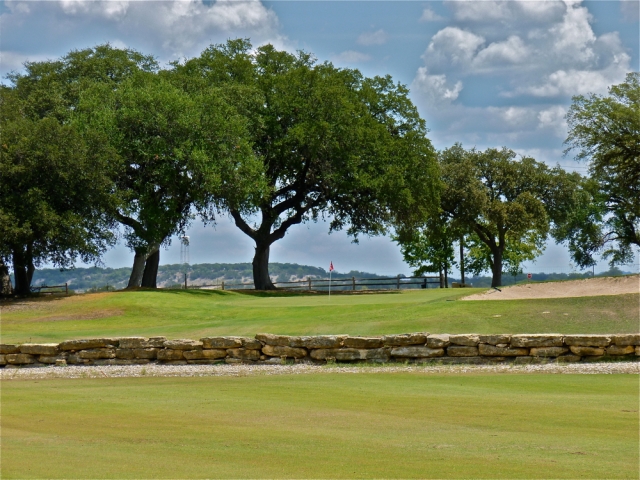
Today was a sparkling, air cleared of pollen after the rains, spring day, a perfect day for a round of golf. The picture above is a shot of the 12th green at Scott Schreiner Golf Course in Kerrville, TX, where I played. You’re looking back at the 12th green from the 13th tee. The 12th fairway runs off to the left of the photo, so you approach the green from over the pond on the left edge of the picture.

The course is a well-maintained municipal track, one that I don’t play as much as I’d like. It’s about a 45 minute trip from my house, not much different from any course I play except for my home course. One unfortunate side effect of not playing Schreiner much is a lack of local knowledge, and it’s a course with a lot of elevation changes, forced lay-ups or carries, and some holes that I have to play a few more times before I can figure out the best approach.

After I figured out that I was swinging with all arms and shoulders and no lower body, I started hitting the ball pretty well. I’d been wondering why my drives were getting weaker and I was always pulling my shots, and maybe keeping my lower body in the game will help correct that. We’ll see. Things were definitely working better after I realized that I’d become lazy below the waist.

Of course, I still didn’t know where to hit it on some of those holes. I hit it where I wanted to. I just shouldn’t have wanted what I wanted.

I guess you really should be careful what you wish for.

Posted in golfing memoir | Tagged , , | Leave a comment

Putting Science Vs. Art: The Pelz and Stockton Debates

Dave Stockton’s book Unconscious Putting got me to thinking about the art vs. the science of putting. I’ve always liked Dave Pelz and his Putting Bible, and it’s a real “putting as a science” book. This shouldn’t be any surprise, because Pelz was a NASA research scientist before he became a short-game guru. I like his book because it’s so data-driven and minimizes the “this is my opinion about what works” part of golf instruction.

It often seems like you’re being asked to buy something when you read about the golf swing. Is stack and tilt better than the traditional swing? Is the anchored putter better? Just look at these guys that use it! They play great! It can make your life better, too! Pelz doesn’t do this. He just presents the data and lets you decide. You can distrust the data if you want, just like scientists argue about research results, but there’s no sales job. (And I suggest that you have a better reason than “I don’t believe it” if you distrust the data.)

Stockton is more on the art side of putting.  At the risk of greatly oversimplifying, he encourages you to get out of your own way and putt freely. He spends a little time talking about technique, but he’s really trying to get you to free yourself up and just roll the darn ball at the hole. He doesn’t argue against Pelz’s data, he just emphasizes a different part of the game.

Combine the two approaches, and I think you’ve got something. I’m prone to getting overly analytic (surprise, surprise), so I’ve been working on injecting some Stockton into my Pelz. So far, so good. My putting feels a lot better and I’m less likely to miss short putts because I tighten up and pull or push it. I hit the ball past the hole more, with less fear of missing the comeback putt, but I’m still trying to avoid going too far past. I’ve incorporated a little forward press to jump start a free stroke, and it feels good.

I even had 8 one putts in one round last week. Too bad the rest of my game was arguing about swing theory.

Posted in book thoughts, daily golf issues | Tagged , , , , | Leave a comment

Sympathy For The Angel

The "Island Green" 17th hole at the ...

The “Island Green” 17th hole at the at TPC Sawgrass. The teeing ground is off the bottom of the picture. (Photo credit: Wikipedia)

As most everyone knows by now, Angel Cabrera made a 9 on the 17th at TPC Sawgrass and later withdrew from the Players Championship for “personal reasons.” There’s been a lot of speculation in the blogosphere that those personal reasons were mostly “I made a 9 on a par 3 hole,” but I’m going to cut Cabrera some slack on this. I’ve spent too many years playing golf and sitting in the psychotherapist’s chair to bang on him too hard.

As a therapist, I was consistently amazed at how many personal difficulties many of my patients dealt with while they carried on a very successful life. No one suspected what was going on in their personal life, and they wanted it that way. Every now and then the problems would leak through, sometimes for only a minute or so, there would be a brief performance glitch. Assuming Cabrera had something else bugging him, the 17th at Sawgrass could certainly bring it out.

As a golfer, I’ve had plenty of experience with having distractions from even minor problems really screw up my game. Maybe I’m too much a creature of habit, but golf is a game of routines and concentration, and it doesn’t take a lot to mess things up.

Several years ago I was playing in our club championship. I typically don’t play on weekends because of my schedule, but I’d rearranged everything so I could play that Saturday and Sunday. Some things got done, some didn’t, and those undone things were nagging at me. At the time my handicap was varying between 7 and 8, and I was occasionally popping out some pretty good rounds. I felt like my game was good to go.

I hit a bad drive on the first hole, but managed to save a bogey. After a drive into the trees on the next hole I hacked it to a solid 9, and by the time I finished the first nine holes I was so far over par that the rest of the tournament was unimportant. I finished the first day with a 91. I came back the second day and played just to hang out with the guys. I considered withdrawing, but learned that the other screw-ups in the championship flight were guys I liked to play with, so I would have a congenial group on Sunday. Besides, I figured things couldn’t be any worse than on Saturday.

Cabrera wasn’t playing for fun. I bet he couldn’t look at his next day as a nice game with the guys, and it was highly unlikely he’d make the cut. What would you have done in his circumstances?

And my second day? I was wrong. It could get worse. I shot 92.

Posted in PGA Tour, reflections on golf | Tagged , , | Leave a comment

Best Bloomin’ Typo Award

I don’t know if it’s just in my paper (San Antonio Express-News) or if it’s in a lot of papers, but the AP story about Rickie Fowler’s win at the Wells Fargo Championship had a great typo.

The story quoted Fowler saying he was looking forward to playing with Rory McIlroy for a long time, and called him  ”Flower“.

Given Fowler’s colorful wardrobe, that’s got to be the most appropriate typo I’ve ever seen.

Maybe his theme song should be The Orange Blossom Special?


Posted in humor, PGA Tour | Tagged , | Leave a comment

Three Golf Quests

Most of us have set goals for our golf games, but some folks have gone at those goals with a vengeance and then written a book about it. I’ve read three of these over the past few years, and the main thing I’ve learned is that I don’t have the time, money, or drive to stick to that type of a project. It’s fun to read about how other people did it, though.

Tom Coyne decided to take a year and try to get good enough to make it through PGA Q School. His book, Paper Tiger, documents his attempt, including all his hours on the practice tee, tournament play, and physical conditioning. I won’t spoil the Q School part of the story for you, but Coyne did a pretty good job on his weight and handicap. He lost over 35 pounds and his handicap index went from 9.4 to +.4. The overwhelming impression I got is of a lot of very hard work, recounted in an entertaining way.

John Richardson approached the problem a little differently. He was an average golfer, meaning he was shooting around 100 most of the time, and decided to try to shoot a round of par golf within a year. He tells the tale in his book Dream On, so named because golfer Sam Torrance said “Dream on” when asked if such a feat was possible. Richardson’s quest is a bit more realistic than most, because he maintained his job and family life while he pursued the dream. The book reads like a very compressed tale of an average guy’s pursuit of a golf dream. Most of us dream of that great round, but most of us won’t throw ourselves at it like Richardson does.

The Old Man And The Tee, by Turk Pipkin

My favorite of the three books is The Old Man And The Tee, by Turk Pipkin. It’s less realistic for the average guy, because Pipkin had the time and money to travel the world to play golf and take lessons from folks like Leadbetter and Pelz. However, his goal was more realistic than making it through Q School. Pipkin wanted to take 10 strokes off his handicap, which started at a 16. A lot of the charm of the book is in Pipkin’s humor (he’s been a stand-up comic) and his random stories about things other than his golf quest. Besides lowering his handicap, Pipkin wanted to rediscover the joy of the golf he played with his late father, and his reflections on his father and the joys of golf that are unrelated to score give the book character.

I’m never going to try to play with the big boys, like Coyne tried to do, and I’m never going to work as hard at golf as did Richardson. My personal quest is to try and balance having fun at golf with playing well, and that’s a tough enough job for me. I wouldn’t mind trying to strike that balance by following the Pipkin program, but my other interests and my bank account rule that out. Playing with the guys a few times a week and trying to keep my handicap semi-respectable won’t make much of a book, but neither would the rest of my daily life.

Unless you count all the feral cats roaming around my property. I hear there’s a big market for cat stories, and they do entertain me on slow days.

Posted in book thoughts | Tagged , | 2 Comments