How Hard Should It Be?

Phil Mickelson attracted attention saying that the course redesign at the Atlanta Athletic Club created a course that was good for the tournament but bad for the members. He particularly thought the course was too long for the average golfer. His remarks have sparked a lot of discussion, including a conversation on The Golf Channel website.

From what I’ve seen on TV there are plenty of tee boxes, so I’d think the length can be adjusted to suit us “average” folks. Me playing the back tees would be the equivalent of me trying to hit Nolan Ryan’s fastball – it ain’t gonna happen. A little attention to the USGA “Tee It Forward” guidelines should make the length manageable.

However, I’m not sure length is the major problem. If the pros are having the trouble they are with hitting into (and getting out of) the bunkers, getting wet, hitting roots and trees (McIlroy and Woods), bumping up against out of bounds fences (Kuchar), punching out of the trees into creeks (Scott), etc. I suspect the average player will have even more trouble. After all, moving the tees forward should only make the hazards the pros hit reachable for us average folks, and we spray it around a lot more than they do.

That’s not to say I wouldn’t like to try. I’d love it. But I’ve discovered that I like hard courses more than many of the folks I play with. My opinion on the issue can only be based on courses I have played around here and consider to be pretty tough layouts. They’re about 7000 yards from the tips, while Atlanta Athletic is 7467. I don’t play the tips. I’m 61 years old with a 6.3 index.

There’s one course about an hour from where I live that I love, but some of the people I play with dislike. The Bandit has interesting (to me) elevation changes, sloping fairways, tough approach shots, and challenging greens. Lose a shot and it’s very hard to get it back because there are very few easy holes. The greens complexes in particular require thoughtful, well executed approaches. Moving to more forward tees helps a little, but you still have those interesting greens to deal with. I love it. Others don’t. I don’t shoot my best scores there, but I don’t care.

Pecan Valley Course Scene. From http://www.pecanvalleygc.com.

Pecan Valley is also about an hour from my home. It was the site of the 50th PGA championship, and is a beautiful, tight, challenging course. Moving the tees up helps a little because it reduces the forced carries over small creeks, but the creeks are still a significant challenge. In some cases you just move closer to a creek that you need to lay up short of. The greens are tough and well bunkered and trees are plentiful. The design rewards thinking your way around the course, not just banging it long. It’s one of my favorite courses. They have added a new set of forward tees that they say takes care of a lot of the forced carries, but I haven’t played there since they were added.

I guess I’d like to hear from the members at Atlanta Athletic Club. Is the course redesign bad for them? I’ll be glad to come as a consultant if they need a second opinion. I come cheap.

Posted in daily golf issues, PGA Tour | Tagged , , , , , , , , | Leave a comment

The Sand Crab Goes Long

It was a scorcher, and after a quick round in the slightly cool of the morning I wandered into the grill for an early lunch. I figured I was safe from the Sand Crab before noon, but I heard his unmistakable muttering emanating from the couch as I sat down with my ham and cheese. I prayed that he was concentrating too much on the view out the window to have noticed me.

I knew I was nailed when he peered over the back of the sofa at me. “You see that fool out there?” he asked. I followed his point out the window to the putting green, where a lone golfer was baking in the sun. “He’s using one of those cheater sticks, and he’s standing wrong, too.”

The object of Sand Crab’s wrath stood facing the hole as he tentatively swung his long putter. It looked like he was trying to get the feel of putting a new way, looking at the hole rather than the ball and swinging the club beside him rather than in front. However, after a few practice swings his putts went in or burned the edges.

“So?” I asked, chewing the last of my sandwich. “It looks strange, but it seems to work for him. Maybe he read the book.”

“What book? How To Look Like A Dork Without Even Trying? Croquet Made Simple? Those belly putters and sweepers are bad enough, but that’s just too much. Ought to be illegal, if you ask me. All of it.”

“What’s wrong with it, Crabman? The object is to hit the ball into the hole with the club, isn’t it? So what if the club’s long or you stand facing the hole?”

“It’s not golf, that’s what.”

I walked over and stood behind the couch as we both watched the guy on the green putt.

“The sweeper probably saved Langer’s career, you know. And Adam Scott’s using it pretty well. Remember Sam Snead putting side-saddle with that regular putter a long time ago? You’d make it all illegal?”

“It’s not right, that’s all. This game has a lot of tradition, you need to honor it. And those long putters don’t.”

“Featheries were tradition before gutta percha balls came along, Crabman. And then rubber core balls came along. A lot of people said the same things back then. Should we all be playing with feather-stuffed balls? Maybe gutta percha?”

“That guy out there has a feather-stuffed head, that’s what he has.” We both stared silently out at the green as the player put his putter back in his bag and headed for the first tee.  The Sand Crab grinned as he looked up from the couch. “They did make it illegal for Snead, you know.”

“They just said you couldn’t stand astride the line like croquet, Crabman. They didn’t say you couldn’t swing facing the target.”

He grunted in reply. “And what book? You didn’t answer my question.”

Golf’s Sacred Journey. The one they made into the Seven Days in Utopia movie. It’s got a lot about face-on putting in it.”

“Still looks dorky to me.”

I looked down at Sand Crab. He was wearing madras shorts, pink socks, and sandals. The hat sitting beside him had a fishing lure on the bill and ‘bite me’ written on the front. “You ought to wear plus fours, Crabpot. Uphold the tradition for us.”

“That’s different. What you wear doesn’t make the game easier.”

“You figure that long putter and standing facing the hole makes it easier, and that’s cheating?”

“You’re catching on, boy.”

“I don’t see you hitting a persimmon driver, Crabs. And you use a sand wedge for those bunker shots you’re so famous for, don’t you?”

“My favorite club, baby. Slides through that sand like a dream.”

“That club was made like that to make the game easier, wasn’t it? I seem to recall it didn’t exist until Sarazen developed it. Should it have been outlawed?”

The Sand Crab reached over for his hat. “Ancient history, kid. Don’t try to change the subject. You aren’t thinking about putting like that are you?”

“I don’t have a putter like that, Crabman. I tried another guy’s for a few minutes, but probably didn’t give it enough time to see how it really worked for me. I played with a sweeper for a while, but I didn’t putt any better than I usually do. So I’m sticking with my old style for now. But I’d change if I thought something else would do better.”

He laughed as he stood to leave. “Anything would work better for you. You should be out there practicing instead of stuffing your face in here.” He started to leave, but stopped and looked back. “Still working on that short game, are you?” I nodded. “Your handicap still going down?” I nodded again.

He grinned as he settled his cap on his head. “You don’t need no long putter. You just need me to set you straight.” He shot me with his index finger as he turned toward the door.

Posted in The Sand Crab | Tagged , , , , , , , | Leave a comment

I Think, Therefore I Can’t Putt

Watching the WGC Bridgestone Invitational, you get the impression that the secrets to good putting are (1) don’t think, and (2) use a long putter. It’s pretty hard to not notice that Adam Scott uses a sweeper and Keegan Bradley, Martin Laird, and Jason Day are all using belly putters. But the “don’t think” part is what entertains me.

On Friday the commentators were talking about Lee Westwood and his new, faster putting style. Apparently Westwood has been working on not taking so long over putts, presumably to avoid over thinking. After the appropriate set-up by the Golf Channel announcers (I can’t recall who they were on this hole) as Westwood read a putt, they asked viewers to notice how quickly Westwood would stroke the putt after he addressed the ball. Westwood stepped into the putt and went into suspended animation as we all waited breathlessly for that eventual strike of the ball. I was turning blue before he finally hit it. So much for his change to quick, unthinking putting. On the other hand, Westwood did putt pretty well during the tournament.

Rene' Descartes, Portrait After Franz Hall. Image via Wikipedia. "I can't make a putt or I'll disappear."

A lot of bad things can happen as you agonize over a putt.  Not only will you tighten up as you stand over the ball, but you’ll begin to question your line, change your aim, be distracted by stray thoughts, notice the reflection of your putter on the ball, etc. By the time you putt you’ve lost all conviction and commitment to the shot. I know, because I’m an expert at second guessing and over thinking as I freeze over a putt. But I’m not sure that’s the same thing as not thinking.

The best putter I’ve ever played with is Gallon, AKA Four Quarts, a member of my regular group. He swears that only bad things can happen if you think, and he steps in and hits putts with lightning speed. You can never feel safe about winning a hole until he’s putted out, no matter how far from the hole he is.

But he thinks a lot, despite what he says. I’ve had many conversations with him on the green, and he analyzes greens and putts in detail. He has a carefully thought out line in mind, and is surprised when the break or speed doesn’t match his ideas. But he does all the thinking before he steps into the putt. He thinks while he develops the plan, but he executes quickly, without additional thought.

So it may be more a matter of commitment rather than not thinking.  After all, if Dave Pelz can write a 394 page book about putting, there must be some thinking involved. Think out the putt and then execute without further delay. Don’t let second thoughts cloud your mind. Just like any other shot.

And those long putters? Talk to Robert Garrigus.

Posted in daily golf issues | Tagged , , , , , , , , | 1 Comment

Get Back In That Place

The last cut on Jerry Jeff Walker’s Viva Terlingua! album is London Homesick Blues, by Gary P. Nunn. As the Lost Gonzo Band plays the intro you can hear Gary mutter into the microphone as he gets ready to sing, saying “Gotta get myself back in that place.” You can almost see him slipping back into a cold, rainy London day and the mood he needs to feel the song.


Golf is a game full of distractions. We constantly distract ourselves with stray thoughts evaluating our play, the pace of play, the weather, what we had for breakfast, etc. As if that wasn’t enough, we also are at risk for being distracted by our playing partners, cars on the road running beside the fairway, the bozos on the next green yelling “Take that, sucker!”, the bug crawling across the green in our peripheral vision, yada, yada, yada. Before hitting that little white ball we need to emulate Gary P. and get ourselves back in that place where we feel and see only the shot at hand.

That’s what everybody says the pre-shot routine does, but my problem is getting to the place where my mind is quiet so I can slide easily into the pre-shot routine. I have no idea if this is common, but I’m at risk for getting caught up in what’s flying around inside my head and outside my body until I’m just mindlessly stepping up and whacking the ball. My decisions get stupid, my swing gets choppy, and my score goes in the toilet. If I’m rushed getting to the course and onto the first tee, my round can be DOA.

There’s a little book I found at my local bookstore that entertains and provides a lot of ideas for how to manage the mental side of the game. Be The Ball is full of short quotes, stories, and advice from everyone from actors to golf pros. None of them fit everyone, but some will fit most anyone. Lee Trevino contributes a lot to the book, so it is often as humorous as it is instructive. I can’t say that what I’m doing now is based entirely on something I saw in the book, but the book made me think about it.
My current strategy to regain focus seems to be working, as long as I can remember to do it. In my former life as a psychologist I treated a lot of headache patients. One of the things I did was relaxation training, and it occurred to me that I might be able to use that skill in my golf game. A quick little relaxation exercise clears my head, relaxes my grip, and has a chance of slowing down that choppy swing, assuming that I catch things early enough. I can get back on the golf course, away from the distractions, and into my game. I’m back in that place.


Posted in book thoughts, daily golf issues | Tagged , , , , , , | Leave a comment

Throw Like A Pro With Grip Grease!

You’ve got that quacker into the trees down pat. You can banana with the best. But what separates your game from the pros? What keeps you on the munis while the big sticks get invited to play the exclusive clubs for free? You can’t throw it like a pro, that’s what!

Ever wondered how Anthony Kim and Tiger can let that driver slip effortlessly onto the tee box as they point to to right field? Babe Ruth couldn’t call a homer with more grace and elan, right? And how did Gary Woodland let that iron on 18 at Old White plummet to earth while he watched, disgusted, as his shot hit the green?

Our Pro-Line Grip Grease, that’s how!

Specially formulated to encourage a smooth release as the club decelerates, Grip Grease lets you sling it like a pro! Just rub a little Grip Grease on the clubs of your choice before each round. Guaranteed not to slip while you’re swinging for the fences, Grip Grease gives you total control of that fling on the follow through. With a slight release of finger pressure Grip Grease lets that club dive to earth like your favorite kite did on your eighth birthday. Remember how much that hurt? Remember the disillusionment when you realized the world wasn’t really fair and it didn’t exist just to make you happy? Remember … Oops, my bad. Got lost for a minute there. Give me a minute.

I’m back now.

Each order of Grip Grease includes our instructional DVD, with inspirational tosses of the club for you to emulate and suggestions for which clubs to grease. We’ll let you in on the secrets of picking the clubs with the most potential for spectacular misses and those with the best chance of good shots you can look profoundly disappointed with.

Grip Grease is also an excellent training aid! Put a little on your putter and you’ll stroke it with confidence. Just a few decelerations and those embarrassing putter drops will fix your problem pronto.

Have trouble committing to those tough shots? Tend to chicken out and decelerate at the critical moment before impact? Grip Grease can help. Your friends won’t ever let you forget that time you threw your wedge into the ball, so you’ll never decelerate again. Swing it hard, bang it long! Hang on!

Grip Grease is available only by special order, so act now. Supplies are limited. I’m almost out of bacon.

Posted in humor | Tagged , , , , | Leave a comment

The Sand Crab Speaks The Truth

I came out of my funk with a start when I heard that rasping laugh. I’d been staring out the window too long and lost track of time. Now I had to pay for getting lost in my own black thoughts. The Sand Crab was moving in for the kill.

“Where you been, Doc?” he asked. “I thought you were going to report again last week.” He slid into the empty chair at my table, neatly blocking any chance I had of an easy exit.

“I just got busy, Crabpot. I’ve been keeping track of putts and greens in regulation, though. I’ve done pretty good. Eleven out of my last twelve rounds at 80 or below, nine of them in the 70s. The most consecutive rounds in the 70s I’ve ever had, so not bad for me.”

He nodded as he scratched the side of his nose. “So why’re you looking like your best friend just died? Troubles with the little lady? Your cat run away or something?”

“No. I just finished the worst round I’ve had in a year or more. That string of scores I told you about didn’t include my round this morning.”

The Sand Crab leaned over the table like a drug dealer about to make me an offer. “So what’d you shoot? Eighty-five? Eighty-eight?”

I leaned in toward him. “I shot ninety-one, Crabman. Ninety-one.” I was almost whispering.

Lucy the cat staring at the camera.

Image via Wikipedia. Photo by Geniac.

He recoiled back and stared at me in mock amazement. Then he started laughing. “Ninety-one!” He was laughing so hard he was nearly shouting. “Ninety-one! So that’s why you’re staring out at that beautiful day like you’ve just come from a funeral. You thought you had scores like that out of your system, huh?”

I started to say yes, but realized that would sound ridiculous. When I stayed silent, Sand Crab leaned back in toward me.

The Golfer's Mind, by Bob Rotella

“You fiddle around on the computer, right?” When I nodded, he went on. “Me too. I saw  this post over at The Armchair Golfer. Something from a real popular Golf Digest article and a book by Bob Rotella. You know him, I’m sure, you being a psychologist and all that.”

“I know of him, sure. He does good stuff.”

“Right. Well, some of the things in that article were about not letting yourself get upset about anything on the golf course. You’re out there to have fun, not shoot a score. It’s the process, not the result. You know all that stuff, right?”

I smiled and nodded. “Sure. But it’s hard to remember when you’re playing like I was.”

“And you thought what would happen? Your round would go down in history with Van de Velde’s finish at the Open? They’d mention your score in the same breath as McIlroy’s back nine on Sunday at Augusta? You ain’t good enough to get that upset over a bad round, Doc.”

I looked at The Sand Crab, not sure whether to feel insulted. He took advantage of my silence again.

“You’re not good enough. Remember that. Nobody else cares what you shot. And they’ve seen you play crappy before.”

I stared at him in amazement. He was making me feel better and insulting me at the same time. “You are a piece of work, Crabman. Let me buy you a beer.”

“I thought you’d never ask. And while we’re waiting, you can tell me about that round. I’m short on entertainment today.”

Posted in The Sand Crab | Tagged , , , , , , | Leave a comment

When Stupid Is Smart

I generally try to play a hole in the way that makes the most sense to my game. I’m more likely to lay up than try the heroic shot because the long run pay-off is higher for me, even if the short run thrill is lower. I’ll try to hit the fairway rather than cut distance off in the rough because I feel better about a long shot with a predictable lie. But I think I’ve finally found the hole where my rules don’t apply.

The fifth hole on my regular course is a 378 yard dogleg left par 4. Trees line the narrow fairway down to the dogleg. Hit the perfect drive down the middle to the center of the dogleg and you have a 100 yard or so wedge into the green. Hit it a little too far, and you catch a fairway bunker. A little too short, and trees block your shot to the green. You can hit it over the trees if you are in the perfect spot, but it’s a very small spot. There are also a few places in the fairway you can hit short of the dogleg and then hit a short iron through gaps in the trees, but these are also small spots.

Out of bounds hugs the right side just past the trees, and the ground in the right rough slopes severely toward OB. To the left is a line of trees, a cart path, and a waste area extending to the dogleg. The waste area is dotted with small bushes. To the left of the waste area are more trees.

For years I tried to hit the fairway. Sometimes I had a shot to the green, but I hit a lot of trees, occasional out-of-bounds shots, and many good drives that gave me no shot. I tried irons to safe spots, but the fairway slopes and doesn’t hold predictably enough for the ball to stop at a predictable distance, so irons were a crap shoot.

So I got stupid. I now just bang the ball as far as I can over the trees on the left and down the waste area. If I miss the bushes, I have a little punch and roll shot into the green. My scores have been much better on average. I never go out of bounds, and an unplayable drop from a bush still gives me a chance at a par putt after a decent approach shot.

So what’s the lesson here? I have no idea. I guess I’ll keep trying to play my version of smart, but stay ready to welcome flashes of stupidity.

Posted in daily golf issues | Tagged | Leave a comment

So That’s Why They Do That

There’s an old Andy Griffith routine from way back before his Mayberry and Matlock days. In Football he describes the experience of a hillbilly watching his first football game, trying to figure out the rules and the object of the game on the fly. All he can figure out is that two groups of guys keep doing strange things to the “pumpkin” and to each other.

Andy Griffith, Tony Award-nominated and Emmy A...

Image via Wikipedia

I was watching the end of the Open Championship (AKA British Open) today and wondering what old Andy’s character would have made of the event. He’d see a lot of people watching from grandstands and other folks traipsing about the open links near the sea. Alleys are cut in the weeds, and everyone’s attention is focused on the few people special enough to walk down the alleys. There are multiple groups of these special people, and two extra special people in each group get to swing a stick and hit a ball. Everyone goes silent when this is happening, and then the observers clap, groan, and/or erupt into wild cheers. For some strange reason the guys hitting the ball sometimes hit it into the weeds, sometimes into big holes full of sand, sometimes into the short grass, and every now and then they hit it into a little hole in the ground. This continues for hours, until finally one of them is given a pitcher and a few others get medals and silver plates.

Football makes more sense. At least in football you can see that one group of guys is competing with another group, although it’s hard to see why. Most games are like that – you can see two players or two teams struggling with another, trying to hit a ball past the other guys, run past the others, knock the other guys ball away, etc. You can kind of see that it mimics a survival skill such as taking territory, getting and keeping treasure away from enemies, or fending off an attack from a predator.

But what’s the good of hitting a ball into the weeds or a hole in the ground? And what are the other people doing there? Golf seems to have no survival value, to mimic nothing of value to the average caveman. You can’t even hit the other guy with your sticks or mess with their ball.

I think Andy’s hillbilly would come away from the Open a little confused about the rules and what was happening, but he’d know why it happened. He couldn’t miss the joy of Darren Clarke, the affection of the crowd and the other players, the coming together of everyone on a fine patch of land by the sea. He’d see everyone drift away for home in a fine mood, leaving empty alleys in the weeds waving in the sea breeze. And he’d wonder, “Could I hit that ball with that stick? It doesn’t look too hard. What’s the big deal?”

A few swings in the quiet evening and he’d know why they cared.

Posted in reflections on golf | Tagged , , , | Leave a comment

Young And Old Tom Ride Again?

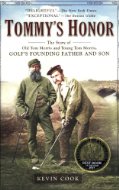
There’s a scene in Tommy’s Honor where Old Tom Morris is asked “What have you brought this laddie here for?” The question from Willie Park, the reigning Open champion, is in reference to Young Tom Morris. Young Tom showed Park why he was brought to the 1867 Open at Carnoustie by beating him in a playoff. Old Tom’s play was beginning to fade at this stage of his life, as short putts got the best of his game.

Tommy's Honor, by Kevin Cook

I couldn’t help but remember this scene as I watched 20 year old Tom Lewis play in the first round of today’s Open, paired with 61 year old Tom Watson. Lewis may not be Watson’s son, but his parents named him Tom in Watson’s honor. Watson seemed thrilled with his namesake’s performance, a 65 that tied Thomas Bjorn for the lead.

It’s a long way from the first round to the claret jug, and a bet on Tom Lewis is an overwhelming long shot. But for a moment on the 18th green today, we may have caught a glimpse of 1867 and the smile of Old Tom at Young Tom’s performance.


Posted in book thoughts, PGA Tour | Tagged , , , , , , | Leave a comment

A Golfer Looks At 60

Jimmy Buffet leads off the B side of his 1974 album A1A with A Pirate Looks At 40. The song is the musings of a lover of the sea, looking back on the years so far. (Buffet is past 40 in this picture, but he looks appropriately pensive.) I’ve been doing something similar, but much less poetic and smaller scale. I’ve been looking back on my last five years or so of golf, the years that bridge my 60th birthday.

Jimmy Buffett, Miami Book Fair International, 1989

Image via Wikipedia. Jimmy Buffet at Miami Book Fair International. By MDCarchives.

My golf scores have followed a regular pattern. My handicap goes up in the winter, creeping into the double digits by February or so. It then begins a slide down through the warmer weather, reaching a minimum around October. It then holds for a while, waiting to begin its upward creep as the weather cools.

I stayed in single digits all winter this year, and my handicap is sliding down a little faster than usual this summer. So what’s different?

I’m not playing more this year. In fact, I’m playing a little less. That may actually be a good thing, because when I play I’m more eager for the game. I’m not practicing more, either. I haven’t been to the range except to hit a few warm-up balls, and with the exception of a little putting on the carpet, I haven’t worked on my short game.

I’m playing with irons that fit me better. I got my new set last year, and I know I’m hitting them more solidly more often, so that may be some of it.

I’ve lost a few pounds, but not many. I’ve always been in decent shape, and I haven’t done anything serious to get into better shape, so I doubt that’s a significant factor. I have found that oatmeal makes a good breakfast, and it holds me longer into the round that most other meals. (Try it with brown sugar, cinnamon, dried cherries and strawberries. And use the stuff you really cook – not instant. It’s good.)

But there has been one change that makes the most sense to me. I’m paying attention. As I mentioned in my post Report to the Sand Crab, I’ve recently been tracking my greens in regulation and number of putts. There’s substantial psychological data that shows that just measuring a behavior is likely to lead to a change. Keep records of your calories, and you’re likely to consume fewer just because you’re paying attention. It’s kind of like the Heisenberg Uncertainty Principle – measuring something changes it.

More than that, I’ve been trying to keep my head in the game and not get distracted by stray thoughts or other people’s games. I’m trying to enjoy Stooge Ball at the same time I keep my head in my own game. I’m trying to stay in the moment, whether the moment is ridiculing the Chipping Lizard for his last shot or it’s going into the cone of silence so I can focus on my own shot.

So we’ll see how it goes, and if it holds up. I’m betting it’s the oatmeal.

Posted in golfing memoir | Tagged , , , | Leave a comment