More Than A Pair Of Pricklies

They’re playing the Valero Texas Open now, and although I can’t get out to the course to watch, I’m always entertained by the way where I live is presented and discussed. It isn’t just Texas – when I lived in Florida I was equally entertained by all the palm tree and gator shots.

First, a short note to the Golf Channel folks. That was a rat snake, not a rattle snake, that you showed on Thursday. I’m no herpetologist, but it didn’t have rattles or the correct markings. To your credit, you noticed the lack of rattles, but then you suggested it might be a baby rattler. It was at least 3 feet long, guys. I don’t know about the baby snakes where you come from, but even in here in Texas, the home of “Where Everything’s Bigger,” they aren’t 3 feet long.

Don't hit it anywhere that looks like this. Trust me. I know.

Next, it’s always fun to see players hitting out of the kind of rough I deal with every day. Kevin Na was the best example with his 16 last year. Yesterday, it was fun watching Justin Leonard punch one out of the rocks and bang his club into a little live oak on the follow through, but that was Justin Leonard. He’s no stranger to Texas or the Texas Open. The best thing about that shot was that guy watching him. He was leaning in the crook of the tree about 3 feet away from Justin. Why didn’t Leonard ask him to move?

And on the subject of the tournament itself. I know this isn’t a major, and it isn’t the biggest event on the PGA tour. But it’s a tournament with a long and honorable past. It started in 1922, was the first tournament Ben Hogan played as a professional, and has been won by the likes of Snead, Nelson, Hogan, and Palmer. So when Jason Sobel said that Lee Westwood playing in some rinky-dink Malaysian event that wasn’t even the biggest tournament in the Far East this week was the same as Matt Kuchar playing in the Valero Texas Open, that’s just wrong. (Sobel said this on Morning Drive this week.) And thanks, Gary for arguing and saying the field at the Malaysian event makes the Texas Open look like the U.S. Open.

Finally, and this isn’t specific to this event, does it drive other people a little crazy when announcers keep using new sponsor names when they talk about historical tournaments? The Texas Open was Hogan’s first pro appearance, not theValero Texas Open. Sam Snead owned the Greater Greensboro Open, not the Wyndham Championship. I have nothing against sponsors attaching their names to tournaments. The money and publicity they provide makes an immeasurable contribution to the game. But let’s maintain a little historical accuracy.

And with that, I close this rant. Thanks for listening, and have a nice day. I need to go saddle up my pony and check the fence line. I’ve got some coyotes hassling my livestock.

 

Posted in humor, PGA Tour | Tagged , , , , , , , , | Leave a comment

What’s In A Name?

Last August while I was bemoaning the state of my putting and discussing the debate about putter length I jokingly suggested that Robert Garrigus would be a good person to talk to about the need for a long putter. At the time Garrigus was using a 28 inch long putter that looked like a kid’s toy.

Somebody must have talked to Garrigus over the winter, because now he’s using a 46 inch sweeper and he swears it’s great. I don’t know how his short and long putter stats compare, but I love the way he names his putters.

The short one was called Mini-Me, and when he changed to the long one he kept the Austin Powers movie theme going and named it Dr. Evil.

I’ve never considered naming my putter, and maybe that’s why it betrays me so often. I guess anything that spends that much time with me and gets called the equivalent of “Hey you” could build up some resentment. At least that’s what I hear from my wife.

Anyway, I’ve been mulling over proper names for my putter. I’m not a big movie guy, so I haven’t found any inspiration there. And I’m not sure if I should go for honesty or hope with the name. I’ve thought about Benedict, after Benedict Arnold, because that club betrays me more than any other in my bag. And if it starts to treat me right, I could always tell it Benedict is Ben Crenshaw’s real first name.

I’ve also considered Corey, because it could go both ways, too. Treat me right, and it’s Corey Pavin. Treat me like it does most of the time and it’s Wrong-Way Corrigan.

But I think I’ve settled on calling my putter Spenser. I’ve always liked the Robert B. Parker detective. He’s a lovable tough guy that’s always getting into and causing trouble. He often does things the hard way for reasons that are apparent only to him. He puzzles over things, tries to analyze the situation and read the clues. He may get them wrong, but then he picks up from the mess he finds himself in and tries again.

That sounds a lot like my putting.

Posted in reflections on golf | Tagged , , , | Leave a comment

The More Things Change …..

A little over a year ago, I commented on the new fairway woods (metals, that is) Adams was advertising and how I never could trust a fairway wood. I have always been mystified by the people that filled their bag with those clubs, claiming they were easier to hit than irons. I’d read golf instruction columns and books that talk about how nicely a fairway wood sweeps the ball off the turf and how easy it is to get that ball airborne. Meanwhile, I burned every worm on the course.

I really do like this book. I'm just allergic to my 3 wood.

David Leadbetter has a nice picture of a fairway wood resting behind a ball and rhapsodizes about how “inviting” it looks and how it’s “great for your confidence.” When I hit a nice drive on a par 5 I just hope it isn’t long enough to “invite” me to try a fairway wood for the next shot. That’s confidence?

For a long time, the only reason I carried a three wood and a five wood was to provide a comfortable resting place for my right forearm as I carried my bag. My arm wasn’t comfortable if I had only a driver in my bag.

So, imagine my surprise when I heard people start to talk about how the three wood was the hardest club in the bag to hit. (I wish I could remember who said this. It was one of the big-time announcers a few months ago, but I was so stunned I was paralyzed and I didn’t write it down.) I also saw some discussion about how it was often better to hit driver instead of three wood because of the amount of technological improvement in drivers as compared to fairway woods.

So maybe that’s where the change in commentary is coming from? With all the improvements showing up in fairway woods it’s now OK to say they are hard to hit? Unless, of course, you go out and spend some large cash on a new one? I’m all for buying a better game; I’m just tapped out.

Alternatively, I’ll be happy to review any of those new fairway woods. All you manufacturers out there, just send me an email and I’ll arrange to give your baby a whirl. I can honestly say that my three wood is the worst club in my bag, so if your club helps my game I’ll sing its praises to the rafters. As it is, the only thing I’ve found to improve my three wood shots is a great lie.

I tell great lies about my second shots on par 5s.

Posted in daily golf issues, humor | Tagged , , | Leave a comment

Golf On the Couch

Back in the days of yore when I did a lot of psychotherapy I was sometimes surprised when a patient would suddenly latch on to something I did or said. It was often the umpteenth time I’d suggested the same alternative behavior or made the same interpretation, but for some reason the timing was finally right and “Voila! Houston, we have progress!”

The more therapy I did, the better I got at sensing when the time might be right, but it was still rare that the first intervention was sufficient. Most of the time I’d have to sit back and wait for the time to be right again, and repeat the process. The few times where one and only one interpretation led to significant change were impressive and memorable.

Correspondingly, beating my patient over the head with an interpretation or behavioral suggestion wouldn’t work, no matter how correct it might have been. In fact, it could make the person worse. If the timing was wrong, it would either be misunderstood, lead to a negative experience, or interfere with the therapeutic relationship.

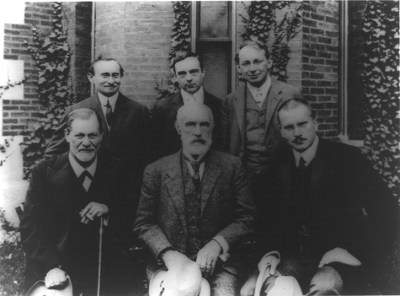
Do you think these guys took their therapy techniques to the course?

Working on my golf swing, either by myself or with an instructor, reminds me of that therapeutic process. Making a tweak in my set-up or swing may or may not be helpful, depending on whether that tweak fits in with the overall pattern of my swing at that time. Trying to release properly when my balance is wrong only makes things worse, but when I get the balance problem worked out, the release can help a lot.

I had a golf buddy (now deceased, but for reasons totally unrelated to this post) who came to the course every time with at least one new swing idea, usually gleaned from golf magazines or TV. I tried to go deaf and nod politely as he explained his new tip(s). If I listened, I was in danger of trying to insert something into my swing that would screw me up for that round, at the least. Even if it was theoretically correct or useful, it was highly unlikely the rest of my swing was ready to incorporate the new technique. The timing was just wrong.

My buddy also never seemed to progress beyond bogey golf. I think a lot of the reason he stayed at that level was that he never repeated the same tip twice. He was off to something new every time and never worked over and over at incorporating the change. If it didn’t work the first time, it was history.

As I’ve mentioned before, my swing blew up on me several months ago and I’ve just now started to get a better feel back in my game. There were some environmental reasons for the blow up (drought, thin fairways, winter chill and winds) but I think mostly it’s because I made a change at the wrong time, and that led to disaster. I fiddled with my stance, that caused a fundamental shift in everything else, and the house of cards collapsed. In therapeutic terms, I tried to force a behavioral change into a system that wasn’t ready, and I got worse.

So I’ve been rebuilding my swing a step at a time and have actually simplified things. I understand my swing better than I did before the crash and have a pretty good idea of what’s wrong when things aren’t working. My handicap isn’t all the way back, but it’s on the way. Now I can modify my stance and work on my release without too much added confusion.

I wish it was going a little quicker, but I always was a long term therapist.

(Image of Freud, Jung, and others via Wikipedia. Image in the public domain.)


Posted in golfing memoir | Tagged , , | Leave a comment

Sliding Around The Dogleg

“You can’t curve the modern golf ball.”

I’ve been entertained and puzzled whenever I’ve heard this comment. It just didn’t fit my personal experience, and after Bubba Watson’s Masters victory I have a very good chance of not hearing it again.

I’m standing on the first tee watching the groups in my weekly skins game tee off. It’s a nice opening hole, a gentle dogleg right par 5 with O.B. right and a lot of room to the left. As the twenty or so players tee off I see high and low slices out of bounds, low snap hooks into the left rough, and high, arching hooks even deeper into weeds. So, I think, “Maybe they mean you can’t curve the modern ball on purpose? That doesn’t make much sense.”

So I hit one down the right side, but in the fairway. To get around the dogleg I need to hit a fade (or slice) around the trees guarding the corner. I open my stance a little and give it my natural, crappy swing with no effort at hitting it well. I just let my body do what it did all the time back when I was a bogey golfer at best. Most of the time it slides around the corner, assuming it doesn’t slide too much and hit the trees or I don’t hit it with my new and improved swing. “Can’t curve that ball? Sure.”

And then there’s Bubba. My slider around the corner looks straight compared to what he can do, and he can do it on command both ways. I doubt he’s playing with an old liquid center, wound, balata ball. (Didn’t you love to cut those things open and watch the rubber bands unwind? And I always wondered what kind of liquid was in that center. It smelled kind of funky, but I never had the courage to taste it.)

So thanks, Bubba. You gave me another great Masters memory and maybe, just maybe, removed one irritating bit of conventional wisdom from my world.

Of course, your game has the possibility of clearing out a lot of that conventional wisdom.

Posted in daily golf issues, PGA Tour | Tagged , , | 2 Comments

My Masters Memory Bank

I look forward to a lot of golf tournaments, and I really enjoy watching the majors. But nothing compares to how I feel about watching the Masters. It’s a rite of spring for me and I don’t feel like my year is off to a proper start if I miss it. The year that Zach Johnson won (2007), the same storm that made Augusta National play so tough blew through Texas on it’s way to Georgia. A lightning strike took out my satellite dish and receiver, so I was without TV during the tournament. Now I get nervous whenever we get a thunderstorm warning the week before the tournament.

I think a lot of the reason I feel the way I do about the Masters is that it’s always played on the same course. It doesn’t hurt that it’s a stunningly beautiful course, but mostly the reappearance of those same scenes, year after year, builds a wonderful collection of memories. I recall great shots at other tournaments, maybe even who won a tournament when and where, but I have a ready file of great shots, years, and Masters winners burned into my brain.

There’s something about this year, maybe it’s the lack of blooms on the course, maybe it’s the crowded leader board, that reminds me of 1975. That was the year that Miller, Weiskopf, and Nicklaus fought it out on the final day. (Jack won.)

My wife and I were living in Lubbock, Texas, in 1975 and often played golf with another couple. I went to grad school with the guy, and the four of us had become good friends. I always enjoyed playing golf with him because I was slightly better and he liked to press bets. I could clear 50 cents on a good day, but that was a 1970’s 50 cents and I was a starving grad student. Big money.

Anyway, we went over to the other couple’s house to watch the Masters on Sunday afternoon. We went to their house because we liked them, but also because they had a color TV. (Thus the lack of blooms reminding me of that year.) I’d grown up in a house with black and white TV and my wife and I were poor students at the time and couldn’t afford more than a little black and white portable, so seeing the tournament in color was really uptown. I still have clear mental images of how the course looked that year. I have no recollection of the actual play, except that I was transfixed by the drama and the scenery. I had to look up who won before I wrote this, but I clearly remember scenes from the battlefield.

The only year that competes with 1975 in my memory is 1986, and I’m sure anyone who saw Nicklaus win that day will never forget it. If I have one hope for this year, it’s that Couples can pull off a Nicklaus, but I’ll settle for another beautiful entry in my mental file cabinet.

This one will stand out. It’ll be the one in color without azalea and dogwood blooms.

(Image by pocketwiley, via Flickr, Creative Commons 2.0 license.)


Posted in golfing memoir, PGA Tour | Tagged , , , , , | Leave a comment

They Said What?

I was watching the Shell Houston Open on Friday, and the announcers were discussing Phil Mickelson’s improved putting. He has improved remarkably, going from way down in the putting rankings to near the top. In the course of this discussion, they also mentioned his winning record, and that he is the only active PGA player to have won in each of the past 9 years. One of the announcers then said, (I swear this is the truth. It’s not an April Fools’ joke.) “Phil has been a model of consistency.”

Phil Mickelson at TPC Sawgrass

Stop the presses! Hold the phone! Notify the authorities! The sky is falling, the sky is falling!

I’m a big fan of Phil. I love his game, the things he does for charity, the balance he maintains between family and profession, the grace with which he deals with adversity. But this is the same guy that inspired “What will Phil do next?” His winning record is very impressive, and consistent in its own way, but Phil as a model of consistency? Let’s take a vote.

As if to illustrate that model of consistency, Phil showed up with a different putter on Saturday after putting so well with the old one for the past several months. He then missed a two footer for birdie with that new putter.

The announcers (NBC this time) were discussing his generally excellent play in Houston and observed that his play this week is not at all predictive of how he’ll play next week in the Masters. Model of consistency. Sure.

Phil, I hope you win in Houston and take home another green jacket next week. I wish you were a model of consistency, but then again, you wouldn’t be Phil.

(Image by minds-eye, Flickr, via Wikipedia. CC Share-Alike 2.0 License.)

Posted in PGA Tour | Tagged , , | Leave a comment

Mega Millions Golf

Today was a day made for golf. Spring is here, and the drive to the course was filled with wildflowers blooming in the pastures and hills. The sky was clear, the breeze was light, the temperature in the mid 70’s. We played a course that had been over-seeded for the winter, and the rye grass was hanging in while the Bermuda was just starting to grow. Good lies in the fairways, greens that were smooth and that held. Good friends and good fun.

The scene on my drive to the course.

And miracle of miracles, I played to match the day. 12 fairways, 10 greens, a score of 76. It’s days like this that make it all worthwhile.

What could be better?

Winning the lottery tonight, that’s what.

Posted in golfing memoir | Tagged | Leave a comment

Golf Is A Game Of Redemption

Golf stories are often about the game’s redeeming qualities, about how the game brought someone back from the brink, restoring faith in self and others.

Maybe it’s because golf is a constant struggle to get back on track. Each tee shot has the potential to take us on a stroll down the straight and narrow, but often as not it’s the first step on a torturous path home. Some courses punish every step off the path with a lost shot. The rough is so heavy or the bunkers so deep that a price must be paid. Others leave a chance for a recovery shot, for a good deed that cancels out the bad.

Maybe it’s because golf is ultimately a game against the self. The trouble we find ourselves in is of our own making. No one but us hit that ball into the weeds, no one but us yanked that three footer to lose the hole. No one but us can make that putt to win the next hole.

Anthony Burgess, speaking of the controversial last chapter of his book A Clockwork Orange, said “There is, in fact, not much point in writing a novel unless you can show the possibility of moral transformation, or an increase in wisdom, operating in your chief character or characters.” I’d argue that there is some of that same redemptive element in golf. We find redemption in holing out from the bunker or hitting that miracle shot from between the trees. We forgive ourselves and move on to the next hole, hoping for greater wisdom the next time we face that decision to go for it or lay up.

I’m watching as Tiger Woods walks his own path back. Last Sunday at Arnold’s tournament at Bay Hill there was a smile on his face that I haven’t seen in a long time, maybe ever. His celebration after the final putt looked different. There was less conquering fist pump and more joyful satisfaction. There was even some thanking of those who helped.

Hank Haney’s The Big Miss comes out today, and other books will no doubt be writtien about the trajectory and accomplishments of Tiger’s career. None of us have any idea what that final trajectory will be.

But maybe Tiger’s writing something of his own out there on the course and in other places we can’t see. Something Anthony Burgess would approve of.

(Thanks to Robert Bruce’s 101books.net for the Burgess quote and inspiration.)

Posted in PGA Tour, reflections on golf | Tagged , , , , | Leave a comment

Any Given Course On Any Given Day

Arnold Palmer was on The Golf Channel’s Morning Drive Thursday morning and mentioned that they had changed the 4th and 16th holes at Bay Hill back to par 5’s for the Arnold Palmer Invitational. They had been par 5’s that were played as par 4’s for previous tournaments. Palmer explained that he thought people worried too much about how many strokes under par players were when they should be paying attention to who could “get it done when it counts.”

I was happy to see Palmer take this position because I’ve always thought there was too much concern these days about equipment and technology allowing players to score too low. The point of a golf competition is who can score the lowest at any given time on any given course, and the actual numbers are always hard to compare across the years and on different courses. There’s just too much variation in conditions, equipment, and courses to put too much stock in those comparisons.

We’ve been worried about equipment making the game too easy forever. A little reading in the history of golf will show you arguments about the change from feather-stuffed balls  to gutta percha to the rubber Haskell ball all the way up today’s hottest new ball. I suppose going back to featheries would solve a lot of our problems, and might encourage the Tee It Forward program better than any amount of proselytizing will. I’m ready to start stuffing those leather balls with a top hat full of feathers when the market is there, but I’m not holding my breath.

Tommy's Honor, by Kevin Cook

Take a look at scores in The Open Championship (British Open) in the early days. The book Tommy’s Honor has a lot of this information, and is an interesting read as well. The Open was first played at St. Andrew’s in 1873, and the winner’s score was 180. That’s two rounds of 90. I don’t hear a lot of moaning about the game being destroyed by rounds below bogey golf.

I’m happily embracing advances in club and ball technology, and hope improvements in technology can counteract the deterioration that comes with age. If Bubba can reach par 5’s with driver, wedge, that’s OK by me. I did that once, too. The ground was baked to the hardness of marble and a gale was blowing up my skirt, but I did it.

My surgeon can do amazing things these days with tiny incisions. It’s not because his fingers are that much more nimble. It’s the equipment, and that’s a good thing.

Posted in PGA Tour, reflections on golf | Tagged , , , , | 2 Comments